
Indoor plant fertiliser is useful when a plant is healthy, rooted into a suitable potting mix and making growth that its light and water supply can support. It is not a cure for low light, root rot, drought, pests or compacted compost. Feeding in those situations can add soluble salts without fixing the reason the plant is struggling.
The safest choice is not one universal bottle or N-P-K ratio. It is a product labelled for the plant and growing method, used at the stated dose while the plant is actively growing. This guide will help you decide whether to feed at all, understand the label and choose between liquid, granular and controlled-release fertiliser.
Quick Answer
Most established indoor plants need modest feeding only while they are actively growing. Check the plant, roots, light, compost and any existing fertiliser before adding more. A complete houseplant feed can suit many foliage plants; a specialist product may be more appropriate for orchids, cacti, edible crops or hydroponic systems. Follow the label, avoid stacking products and pause if growth is slow or the plant is stressed.
Do This First
Before choosing fertiliser, answer five questions:
- Is the plant producing healthy new leaves, shoots, roots, flowers or fruit?
- Does it have enough light to support that growth?
- Is the compost draining normally, without a sour smell or soft, decaying roots?
- Does the potting mix, nursery label or group of small coloured prills show that feed is already present?
- Is the proposed product labelled for this plant type, container size and growing method?
If any answer is unclear, investigate before feeding. A yellow leaf or slow week of growth is not enough evidence on its own.
Do Indoor Plants Need Fertiliser?
Plants make sugars using light, carbon dioxide and water. Fertiliser supplies mineral nutrients used to build and regulate new tissue; it does not provide energy and cannot compensate for inadequate light.
Container plants have a limited root zone. Nutrients may be taken up by the plant or lost in drainage water, so an established plant can eventually benefit from replacement nutrients. That does not mean every indoor plant needs year-round feeding. A recently bought or repotted plant may be in pre-fertilised compost, a slow-growing plant may use very little, and a plant in poor light may not be able to turn extra nutrients into healthy growth.
The RHS feeding guide recommends using the minimum feed needed and checking the fertiliser label. That is a better starting point than feeding because a calendar reminder appears.
Feeding is most defensible when all of the following are true:
- the plant is established and actively growing;
- light, temperature and water are suitable for the species;
- roots and drainage appear healthy;
- the existing compost feed has been used up or no feed was included; and
- the chosen product is suitable for the plant and pot.
What N-P-K Means
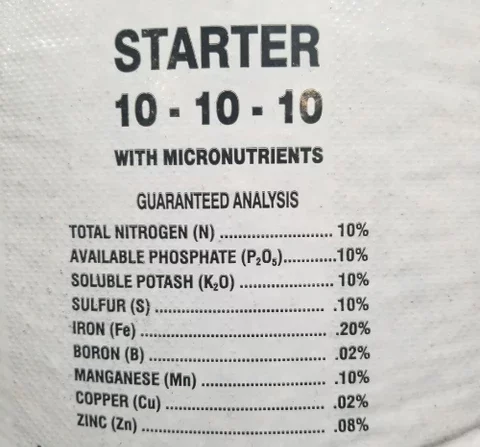
The three prominent numbers on a fertiliser label are commonly called N-P-K. In UK and many international labelling systems, they state percentages by weight of nitrogen (N), phosphate expressed as P2O5 and potash expressed as K2O, in that order. A 10-10-10 product is therefore not the same strength as a 20-20-20 product, even though their three numbers have the same relative pattern.
The Colorado State University label guide explains this distinction. Always use the product’s own measuring and dilution instructions; do not transfer a spoon or capful rate from a different analysis.
Nitrogen
Nitrogen is part of chlorophyll, amino acids and proteins and is important throughout active growth. Too little available nitrogen can contribute to pale or slow growth, often beginning on older leaves, but yellowing is not proof of nitrogen deficiency. Overwatering, damaged roots, low light, normal leaf ageing and salt injury can look similar.
Phosphorus
Phosphorus is involved in energy transfer, cell division, roots and reproduction. A plant requires it, but this does not mean that adding extra phosphorus automatically produces more flowers. Flowering also depends on species, maturity, light, temperature, pruning, watering and the plant’s natural cycle. A high middle number is not a substitute for diagnosing the real limiting factor.
Potassium
Potassium helps regulate water movement, enzyme activity and several processes involved in growth and stress response. It is not a general medicine for a weak plant, and extra potassium cannot correct waterlogged roots or insufficient light.
Micronutrients
Plants also need calcium, magnesium and sulphur, plus much smaller quantities of elements such as iron, manganese, zinc, copper, boron, molybdenum, chlorine and nickel. Micro refers to the amount required, not their importance.
A complete houseplant fertiliser may include several of these, but check the guaranteed analysis rather than assuming. Do not add a separate iron, magnesium or trace-element treatment from leaf colour alone. Root damage or unsuitable root-zone pH can make a nutrient unavailable even when it is present.
What Is a Balanced Fertiliser?
On a label, balanced usually means the three analysis numbers are equal or close to equal, such as 5-5-5 or 10-10-10. Complete has a different meaning: it supplies nitrogen, phosphate and potash, but the numbers need not be equal. Neither term guarantees that micronutrients are included.
Equal numbers are not automatically better. The Iowa State University fertiliser guide notes that an equal N, phosphate and potash analysis does not match the proportions most plants use. For an indoor gardener, the practical question is whether the entire product is labelled for the plant and container, not whether the front numbers look tidy.
A balanced or general-purpose houseplant product may be convenient when:
- you have a mixed collection of healthy foliage plants;
- the label includes an indoor-container rate;
- the plants are established and growing in suitable light;
- the formula includes the nutrients the potting mix does not already supply; and
- you want one cautious, easy-to-measure routine.
Choose a more specific formulation when the plant or growing method has different instructions. Orchids growing in bark, acid-loving plants, food crops and hydroponic systems should not be treated as interchangeable simply because they all need N, P and K. A specialist label is useful only when it genuinely matches the plant; a picture of a flower or cactus on the bottle is not evidence by itself.
What Is Controlled-Release Fertiliser?
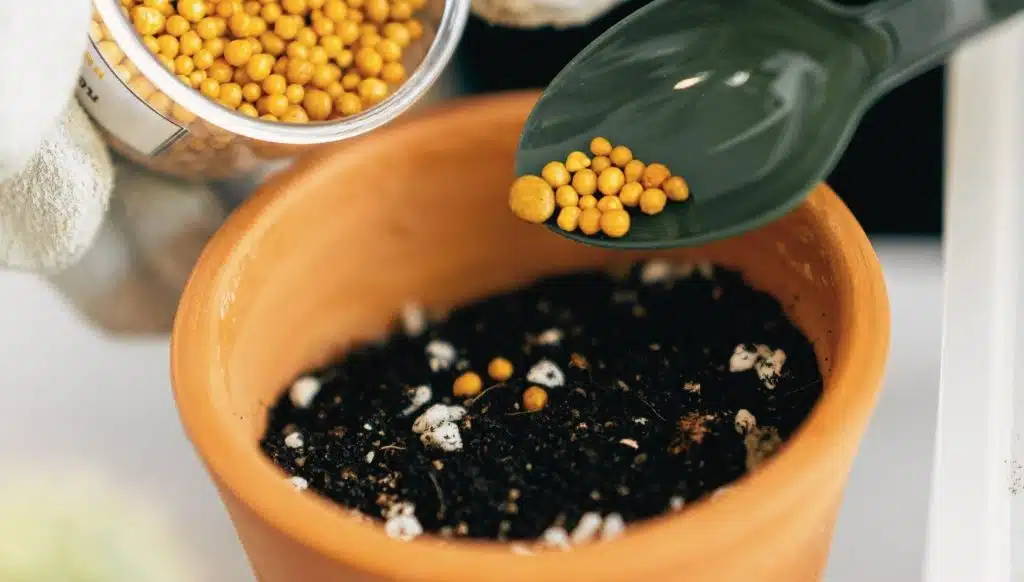
Many controlled-release fertilisers contain soluble nutrients inside coated prills. Water enters the coating and nutrients move out over time. Products may advertise a life such as three, six or nine months, but that is a conditional estimate, not a guaranteed indoor timetable.
Temperature, moisture, coating and placement affect release. NC State Extension’s container guidance notes that higher summer temperatures and greater moisture in the growing medium can increase nutrient release from controlled-release products. A warm, frequently watered pot can therefore behave differently from a cool pot that dries more slowly.
Slow-release and controlled-release are often used loosely in shops, but they are not always technically identical. Coated prills control nutrient movement through a manufactured coating; some other slow-release materials depend more on water, particle breakdown or microbial activity. Read the exact product label rather than assuming every pellet behaves the same way.
Controlled release can be suitable when:
- the plant is healthy and its needs are reasonably predictable;
- the product has a clear indoor-container rate;
- you want fewer applications rather than frequent dose adjustments; and
- the compost does not already contain another fertiliser charge.
It is less suitable when:
- a small or sensitive plant needs close dose control;
- the pot is frequently repotted or its mix stays wet for too long;
- you need to stop or change feeding quickly;
- existing prills or fertiliser are already present; or
- the plant is stressed and nutrition has not been identified as the limiting factor.
The biggest risk is stacking. Once prills are mixed through compost, you cannot remove every one or pause their release. Do not add routine liquid feed on top unless the labels or a plant-specific programme explicitly account for both sources.
Liquid vs Granular vs Controlled-Release Fertiliser
The best form is the one you can measure correctly and adjust to the plant. Granular describes a physical form, not one release speed: ordinary soluble granules and coated controlled-release prills can look similar but behave differently.
On smaller screens: scroll sideways to view the full table.
| Type | Best for | Advantages | Drawbacks | Control over dose | Common mistakes |
|---|---|---|---|---|---|
| Liquid or water-soluble feed | Small mixed collections; growers who check plants regularly; plants needing an adjustable label-led dose | Easy to dilute to the stated rate; dose can be paused or changed at the next application; spreads through evenly moist mix | Easy to make too concentrated; repeated use can add salts; requires more decisions | High | Using a capful from memory; feeding at every watering without label support; treating it as a quick cure for pale leaves |
| Conventional granular feed | A container only when the product gives a suitable pot/compost rate | No mixing bottle; measured dose may last longer than one watering | Outdoor rates may be unsuitable for pots; granules can distribute unevenly or contact roots; release may be hard to judge | Medium to low | Using grams-per-square-metre advice in a small pot; guessing a teaspoon; leaving concentrated granules against stems or roots |
| Controlled-release feed | Healthy, established plants with predictable needs; larger pots where a labelled low-maintenance option is helpful | Fewer applications; nutrients released over an extended period; less day-to-day mixing | Difficult to remove or stop; longevity varies with conditions; hidden prills can be forgotten; may release too much if stacked | Low after application | Adding more before the stated period ends; mixing into pre-fed compost; adding liquid feed on top; assuming pellets are empty because the plant slows down |
How Often Should You Fertilise Indoor Plants?
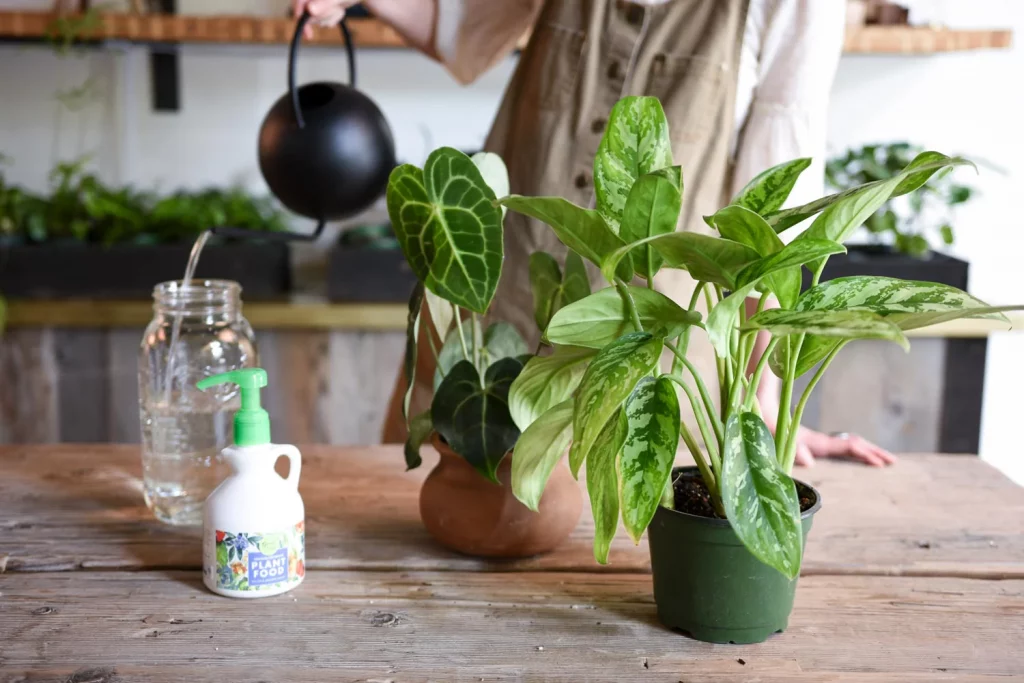
There is no reliable calendar interval for every houseplant. Use the label as the outer rule, then feed only when the plant and growing conditions justify it.
Work through this decision each time:
- Look for active growth. New leaves, roots, shoots or flowers are better evidence of demand than the month name.
- Check usable light. A plant in low light usually grows more slowly and uses nutrients more slowly. Extra feed cannot force healthy growth without enough energy.
- Check the plant type and stage. A mature foliage plant, a cactus in a rest period and a cropping basil plant do not have the same demand.
- Check the root zone. Do not feed waterlogged, severely dry, compacted or rotting compost.
- Check what is already present. Include feed in the compost, controlled-release prills and every recent liquid or granular application.
- Read the current label. Frequency varies with concentration, formulation and application method. Do not reuse instructions from the last bottle.
Season is a clue because UK daylight and indoor temperature often change through the year, but it is not the decision by itself. Many plants slow in winter; some grow under effective lights or follow different seasonal cycles. Feed the growth you can observe, not spring and summer as a universal rule.
How Much Fertiliser Should You Use?
Use the rate for indoor containers, the relevant plant group and the actual pot size or compost volume. If the label offers a permitted range, begin at the lower end for a small, sensitive or newly established plant and observe it. Do not invent a half-strength recipe when the manufacturer gives one fixed mixing instruction.
Keep these safeguards in place:
- measure; do not estimate by eye;
- use the supplied scoop or a dedicated measure where required;
- make the stated volume of solution rather than adding concentrate straight to the pot;
- do not copy a dose from another brand or N-P-K analysis;
- account for every existing fertiliser source;
- never use an outdoor bed or lawn rate in a pot unless the label also provides a container rate; and
- keep fertiliser off leaves, stems and exposed roots unless the label specifically describes that application.
Small containers have less compost to buffer an error. A little excess can create a high salt concentration around a limited root system, so just a splash is not a safe unit.
Plants grown in water or a hydroponic system need a complete nutrient solution formulated for that system and crop. University of New Hampshire’s home hydroponics guidance explains that the solution supplies the nutrients that soil would otherwise hold. Do not substitute an ordinary houseplant feed unless its label explicitly covers the system.
Repotting, Fresh Compost and Existing Feed
Repotting changes both the roots and their nutrient supply. Many commercial potting mixes contain starter fertiliser or controlled-release prills. Check the bag and plant label for the type and claimed duration, then remember that temperature, watering and plant demand can change how long it lasts.
Do not automatically add fertiliser during repotting. The Iowa State houseplant guide notes that little or no fertiliser is usually needed for the first few months when the new mix already contains it. Start later only when the included feed has reasonably been used, roots are functioning and healthy growth resumes.
Repotting into an unfertilised mix is different, but the plant still needs time to settle if roots were disturbed. Follow the mix and fertiliser labels rather than applying a blanket waiting period. If old compost has become compacted, hydrophobic or unsuitable, fertiliser will not restore its structure; review how to refresh old potting mix or repot into an appropriate fresh mix.
When You Should Not Fertilise
Pause and correct the underlying condition when a plant has:
- suspected root rot, soft roots, a sour smell or persistently saturated compost;
- severe wilting caused by drought or waterlogging;
- little or no growth because light is inadequate;
- a very recent repot into compost that already contains feed;
- visible controlled-release prills whose active period may not have ended;
- heat, cold or sudden-location stress;
- an active pest or disease decline when nutrition is not the limiting factor; or
- a natural rest or very slow-growth period.
A weak plant does not need a boost merely because it looks weak. Feeding damaged roots can increase salt stress. Restore appropriate light, water, drainage and temperature first, then wait for evidence of recovery.
Fertiliser Needs by Plant Type
Foliage Houseplants
A complete houseplant product can be a practical starting point for healthy, established foliage plants. Demand still varies: a vigorous plant beside a bright window may use nutrients more quickly than the same species in low light. Do not use dark green colour as the only goal; excessive feeding can produce soft or disproportionate growth.
Flowering Houseplants
Confirm the plant has the light, maturity, temperature pattern and natural season needed to form buds. Choose a product labelled for the species or flowering houseplants if feeding is justified, but do not assume a high-phosphorus product will fix poor flowering. Excess nutrients can be as unhelpful as too little.
Succulents and Cacti
Many succulents and cacti grow slowly or pause under cool, low-light conditions. Use a cactus/succulent-labelled product only during evident growth and at its stated rate. Never combine feeding with an attempt to water on schedule; the compost must still drain and dry in the way the species needs.
Herbs and Edible Plants
Use only a product whose label covers the specific edible crop or crop group. Follow its dose, application method and any harvest interval. A leafy herb and a fruiting indoor crop can have different needs, while too much fertiliser can damage roots or produce poor-quality growth. The University of Maryland container-vegetable guide stresses label use and the salt risk of overfeeding container crops.
Orchids
Orchid needs vary with species, growth stage, potting medium and water quality. Bark-based mixes hold and release nutrients differently from ordinary houseplant compost, and salts can accumulate on roots or media. Use a suitable specialist product and follow its directions rather than applying the routine for foliage plants. See the separate indoor orchid fertiliser guide for a more specific decision.
Signs of Overfeeding
No single symptom proves fertiliser damage, but suspicion is stronger when several signs appear after a recent application or product change:
- a white or pale crust on the compost, pot rim or drainage area;
- brown or dead leaf tips and margins;
- wilting even though the compost contains moisture;
- lower-leaf loss, stunting or distorted growth;
- damaged, dark or dead root tips; or
- sudden decline after a strong or repeated feed.
White crust is not always fertiliser. University of Maryland’s salt-deposit guidance explains that hard-water minerals can leave a similar residue. Review the water source, feeding history and roots before deciding what caused it.
Possible Nutrient Problems
Visual symptoms overlap. The University of Delaware deficiency guide explains that water stress, disease, multiple deficiencies and root-zone pH can confuse a diagnosis. Use this table to choose the next check, not to name a deficiency from a photograph.
On smaller screens: scroll sideways to view the full table.
| Symptom | Check first | Is fertiliser justified? | Sensible next step |
|---|---|---|---|
| General yellowing | Compost moisture; drainage; soft or dark roots; available light; normal ageing of older leaves; recent feed and salt crust | Not from colour alone | Stabilise watering and light, inspect roots and note whether old or new leaves are affected. Use the fuller guide to why indoor plants turn yellow. |
| Pale new growth | Light; root condition; compost pH and water quality; pests; whether the plant is naturally variegated | Possibly, but a trace-element dose is not justified without more evidence | Correct root-zone problems. If an established plant is actively growing and due for feed, use an appropriate complete product rather than one guessed element. |
| Weak or stretched growth | Low light; excessive warmth; overwatering; root restriction; recent high-nitrogen or repeated feeding | Often no; excess feed can also contribute | Improve usable light and root conditions. Pause feeding if growth is soft or the plant has already been fed. |
| Reduced flowering | Species and maturity; seasonal cycle; light duration/intensity; temperature; pruning; water stress; excessive nitrogen | Not automatically | Fix the limiting cultural factor. Use a suitable label-led feed only when the plant is healthy and actively preparing to flower. Do not add phosphorus from this symptom alone. |
| Brown leaf edges or tips | Drying roots; waterlogging; low humidity where relevant; hard water; fertiliser history; drainage and salt deposits | More fertiliser is usually the wrong first response | Pause feed, inspect roots and drainage, and manage confirmed salt build-up only if the pot can drain freely. |
For persistent decline, unusual symptoms or valuable plants, seek a species-specific horticultural diagnosis. A potting-medium or tissue test can be more reliable than repeated trial doses.
How to Fix Fertiliser Build-Up
First stop adding fertiliser. Remove loose surface granules if they can be lifted without damaging roots, but do not dig through the pot searching for every prill.
Next check the container:
- Does it have open drainage holes?
- Can it be removed from a decorative cachepot?
- Does water pass through the mix evenly?
- Are roots firm, or are they soft, dark and decaying?
If the plant is in a freely draining pot and the roots are not rotting, plain-water leaching may help move soluble salts out. Place the pot where it can drain, apply room-temperature water slowly across the surface, allow it to pass through completely and empty all runoff. Repeat only as the plant and mix can tolerate, then let the compost return to the moisture level appropriate for that species.
Do not simply flood a pot with blocked drainage, dense waterlogged compost or suspected root rot. That adds another water problem. A small pot with severe salt build-up, exhausted mix or damaged roots may be safer to repot into a suitable fresh medium after the roots are assessed. University of Maryland’s fertiliser-toxicity guidance similarly distinguishes leaching larger, drainable pots from replacing the medium in severe small-pot cases.
Do not resume feeding until the cause is clear, the plant is stable and healthy growth has returned. When you restart, use one suitable product at the label rate and record the date.
Common Fertiliser Mistakes
- Feeding because it is a new month rather than because the plant is growing.
- Treating yellow leaves as proof of nitrogen deficiency.
- Choosing the highest analysis or equal N-P-K numbers without reading the rest of the label.
- Assuming
bloom boosterphosphorus will solve poor flowering. - Adding feed to fresh compost without checking whether fertiliser is already included.
- Using an outdoor lawn, border or square-metre rate in a small pot.
- Stacking liquid, granular, spikes and controlled-release products.
- Guessing doses with teaspoons, capfuls or splashes from another brand.
- Feeding roots affected by rot, severe drought or waterlogging.
- Flushing a pot that cannot drain freely.
- Using ordinary houseplant feed for edible or water-grown plants without label approval.
- Forgetting that warm, moist conditions can shorten the useful life of some controlled-release products.
FAQs
What Is the Best Fertiliser for Indoor Plants?
There is no universal best product. For many healthy foliage plants, a complete houseplant-labelled feed with a clear indoor dose is a practical option. Choose a specialist label for plants or systems with different needs, and use no fertiliser when growth and root conditions do not justify it.
Does a Yellow Leaf Mean My Plant Needs Fertiliser?
No. Yellowing can result from excessive water, drought, damaged roots, low light, natural ageing, pests, disease, salts or nutrient availability. Check the whole plant and root zone before feeding.
Can I Use Controlled-Release and Liquid Fertiliser Together?
Do not make this the default. Both add nutrients and soluble salts. Combine them only when the exact labels or a reliable plant-specific programme calculate the two sources together; otherwise use one method and monitor it.
Should I Fertilise Houseplants in Winter?
The season name is not the rule. Many houseplants slow as daylight falls and should be fed less or not at all. A plant making healthy growth under suitable light may still use nutrients, but the product label, species and existing feed remain decisive.
How Soon Can I Fertilise After Repotting?
Check whether the new compost already contains fertiliser and wait for roots to function and healthy growth to resume. There is no one waiting period for every mix and plant. Follow the compost and feed labels and do not fertilise merely to help a plant recover from disturbed roots.
Are Fertiliser Spikes Safer Than Liquid Feed?
Not automatically. Spikes are convenient but can concentrate nutrients in one area and are hard to adjust after insertion. Use them only when the label covers the plant and pot size, and do not add another routine feed on top.
FIX THE ROOT ZONE BEFORE YOU FEED
Check Your Watering Routine First
If a plant is yellow, wilted or growing slowly, use the indoor plant watering mistakes guide to check moisture, drainage and root stress before adding fertiliser.
Final Thoughts
Good indoor plant feeding is a decision, not a recurring chore. Confirm healthy active growth, enough light, working roots and no existing fertiliser charge. Then choose one product labelled for the plant and system, measure it accurately and allow the plant’s response—not a universal calendar—to guide the next decision.
Balanced fertiliser can be convenient, but equal numbers are not proof of suitability. Controlled release can reduce application frequency, but it is harder to reverse and responds to temperature and moisture. Whatever form you choose, cautious label-led use is more useful than chasing a quick boost.
Related Articles
BOOST YOUR FERTILIZER EFFICIENCY
Learn How Balanced Fertilizers Maximise Plant Health
Once you understand the basics of indoor plant fertilizers, choosing the right nutrient balance can make a huge difference. Our Balanced Fertilizers guide explains N-P-K ratios, when to use them, and how they support strong, even growth across your garden.