

An indoor smart garden combines a built-in light with a reservoir and a guided growing system, so you can raise herbs, salad leaves or a few compact crops without relying on a sunny windowsill. Its size, growing method and refill system should match what you actually want to harvest.
The four models below make very different trade-offs. If you are still deciding whether this type of system suits your routine at all, first check whether a smart indoor garden is worth it; then return here to compare exact models. The LetPot LPH-Max is the strongest overall option here for someone who wants a larger, app-managed hydroponic setup. The Click & Grow Smart Garden 9 is the simpler choice for a first countertop herb garden. The Véritable Exky SMART is for genuinely tiny spaces, while the Click & Grow 25 is the better fit when leafy greens matter more than a compact footprint. If you want the background before choosing a system, our guide to growing plants without soil indoors explains the basics of hydroponic growing.
Quick Answer
The LetPot LPH-Max is the strongest overall choice in this comparison if you have room for a wider system and are happy to manage nutrients, a pump and an app. Its 21 standard pod positions, 7.5 L reservoir, 36 W light and support for automatic water-refilling and nutrient-addition functions gives it much more scope than a simple herb garden.
For an easier first step, choose the Click & Grow Smart Garden 9. It has nine pods, passive watering and pre-seeded Plant Pods, so there is no liquid nutrient routine or pump to clean. It is better suited to herbs, small salad crops and compact varieties than to a large household harvest.
Do this first
Before buying, decide:
- what you want to grow most often — a few herbs, recurring salad leaves, or taller fruiting crops;
- how many plant positions you realistically need;
- how much clear counter, shelf or floor space you have; and
- whether you are happy to keep buying a brand’s pods/refills, or would rather use your own seeds and separate nutrients.
A six- or nine-pod countertop garden can be very useful for basil and lettuce, but it is not a substitute for a larger vegetable-growing setup. Starting with the crop and space avoids paying for features you will not use.
Indoor Smart Garden Comparison
On smaller screens: scroll sideways to view the full table.
| Model | Best for | Plant capacity | Growing system | Smart control | Main advantage | Main drawback |
|---|---|---|---|---|---|---|
| LetPot LPH-Max | A dedicated hydroponic setup | 21 standard pods plus a larger two-hole tray | Pumped hydroponics; 7.5 L tank; 36 W light | App and 4.6-inch screen; adjustable schedules; automatic refilling/fertilising features | Capacity and control, with a 30-inch maximum light height | More complex, bigger, and dependent on nutrients/pump upkeep |
| Click & Grow Smart Garden 9 | Beginners and everyday herbs | 9 Plant Pods | Passive watering; 4 L tank; 13 W LED | App for care/harvest guidance, not stated as remote hardware control | Simple pre-seeded pod route; no pump | Plant Pods are a recurring branded consumable; limited growing space |
| Véritable Exky SMART | The smallest kitchen space | 2 Lingots | Passive hydroponics; 1 L tank; 7.5 W LED | Adaptive light output and low-water alert; no app | Very compact and low-maintenance | Only two plants and a strongly proprietary Lingot system |
| Click & Grow 25 | More leafy greens in a larger footprint | 25 Plant Pods | Passive watering; 9 L tank; 38 W across two lights | App for care/harvest guidance, not stated as remote hardware control | Large 25-pod format designed around leafy greens | Large, heavy and not a compact countertop system |
How These Smart Gardens Were Chosen
This comparison uses current named manufacturer specifications, a current UK purchasing route, growing capacity, maintenance, crop flexibility and the practical cost of pods, nutrients and replacements.
These recommendations are based on current manufacturer specifications, UK availability and publicly available product information rather than personal hands-on testing.
The shortlist deliberately includes different systems rather than four near-identical countertop units: a higher-capacity pumped hydroponic garden, an easy passive pod garden, a two-plant small-space model and a 25-pod leafy-greens system. UK availability and retailer bundles can change, so check the exact model, plug, starter contents and current stock before ordering.
Best Overall: LetPot LPH-Max
Verdict
The LetPot LPH-Max is the strongest overall choice in this comparison for a buyer who wants a more serious indoor hydroponic system rather than a small herb garden. It has 21 standard pod positions, a 7.5 L reservoir and a 36 W light board. The manufacturer also describes a 4.6-inch screen and app control, two plant-lighting modes, a rotating light panel with a stated maximum height of 30 inches, and support for automatic water-refilling, nutrient addition and cycling functions.
That makes it the most flexible option here for a mix of herbs, leafy greens and carefully managed compact fruiting crops. It also brings more responsibility. You still need to choose suitable seeds, add the right nutrient solution, keep roots and the reservoir clean, and make room for a larger system. “Automatic” should mean fewer repetitive jobs, not that the garden can be ignored.
If the higher capacity suits your space, you can check the LetPot LPH-Max on Amazon to confirm the current exact bundle and availability before buying.
Pros
- 21 standard positions, plus a larger two-hole tray for plants needing more room.
- 7.5 L tank and 36 W light are the most substantial core specifications in this shortlist.
- App and display control, with custom lighting schedules and two crop-oriented light modes.
- The stated 30-inch maximum light height gives more room than a fixed low countertop lamp.
- Own-seed growing is supported through compatible sponges, rather than only pre-seeded branded pods.
Drawbacks
- The pump, nutrients, larger footprint and cleaning routine make it less simple than a passive pod garden.
- LetPot does not publish a numerical pump-noise figure, so do not assume it is silent in a quiet kitchen.
- The official product page shows inconsistent rendered size/stock information, so verify the physical footprint and UK plug/bundle before purchase.
Who it suits: someone who will use a larger garden regularly, wants app-managed lighting and watering functions, and is happy to learn a little about nutrient-based hydroponics.
Who should skip it: someone who only wants two or three herbs, wants no pump maintenance, or has limited counter space.
Best for Beginners: Click & Grow Smart Garden 9
Verdict
The Click & Grow Smart Garden 9 is the straightforward recommendation for someone who wants a tidy indoor herb garden without measuring nutrients or maintaining a pump. It uses passive watering and nine proprietary pre-seeded Plant Pods. You add water, insert the pods and let the built-in 13 W LED follow its automatic schedule.
Its 4 L tank and two lamp extension arms make it more practical than a tiny windowsill planter, while the official starter set includes basil, green lettuce and mini tomato pods. The companion app is useful for plant-care and harvest reminders, but it should not be confused with Wi-Fi control of the hardware; the manufacturer does not state that the standard Smart Garden 9 can be remotely operated.
If that uncomplicated pod system fits your kitchen, you can check the Click & Grow Smart Garden 9 on Amazon to confirm the current exact starter kit and availability.
Pros
- Nine pod positions in a slim 60.4 cm-wide countertop format.
- Passive watering means no pump, pump noise or circulating-water cleaning routine.
- Pre-seeded pods remove the need to mix nutrients for the standard growing route.
- 4 L tank, 13 W stated power consumption and 6.2 kWh monthly manufacturer figure are clear planning information.
- Click & Grow offers Grow Anything pods for owners who want to use their own seeds with the brand’s growing medium.
Drawbacks
- The convenient Plant Pod system creates an ongoing branded consumable cost.
- It is primarily a herb, salad-leaf and compact-variety garden, not a large vegetable harvest.
- The app supplies guidance rather than the advanced remote controls offered by a genuinely app-controlled hydroponic system.
Who it suits: first-time indoor growers who value a clean, guided system for herbs and a few salad crops.
Who should skip it: someone who wants to avoid proprietary pods entirely, grow many plants at once, or manage tall fruiting crops.
Best for the Smallest Spaces: Véritable Exky SMART
Verdict
The Véritable Exky SMART is a very different proposition: it is a two-plant garden for a small kitchen, not a compact version of a 20-pod hydroponic system. Its footprint is 20 cm by 18.2 cm, the 1 L reservoir uses passive hydroponic watering, and the 7.5 W LED has the brand’s ADAPT’LIGHT function, which adjusts light intensity to the ambient brightness.
It earns its place because it makes sense where counter space is genuinely scarce. The flashing-light low-water warning and supplied Lingots keep the routine simple, and there is no pump to maintain. The trade-off is significant: the manufacturer specifies compatibility with Véritable Lingots only, so this is the most locked-in refill ecosystem in the comparison. It also has no app connection.
If you only need a small herb or edible-flower station, you can check the Véritable Exky SMART on Amazon after confirming the exact plug, colour and current bundle.
Pros
- Extremely compact 20 cm by 18.2 cm footprint.
- Two Lingot positions are manageable for a small herb, seedling or garnish setup.
- Passive system avoids a circulation pump.
- Adaptive LED intensity and a flashing low-water alert are useful, targeted features.
- Manufacturer states a two-year warranty.
Drawbacks
- Two plant positions will not supply regular household salad or a large herb harvest.
- No app connection or remote control.
- Officially compatible with Véritable Lingots only, so consumable flexibility is limited.
- The small reservoir needs watching as plants mature and drink more.
Who it suits: someone who wants a visually tidy, small-space garden for a couple of herbs or compact plants and accepts branded Lingot refills.
Who should skip it: anyone expecting a large yield, app control, or the freedom to use generic growing media.
Best for Leafy Greens: Click & Grow 25
Verdict
The Click & Grow 25 is the choice for a larger, more furniture-like indoor garden built around leafy greens. It has 25 Plant Pod positions across six trays, a 9 L water tank and two LED lights with a stated 38 W consumption. At 75.5 cm wide, 43 cm deep and 15 kg, it needs a planned home rather than a spare corner of a worktop.
The manufacturer says it is optimised for leafy greens, although it works with the brand’s plant range. That distinction matters. A large pod count does not automatically make it a good system for mature tomatoes, chillies or other tall fruiting crops. Its format is more convincing for staged salad leaves, herbs and compact plants, where the larger reservoir and 25 slots can be used consistently.
Pros
- 25 plant positions and a 9 L tank support a larger regular leafy-greens setup.
- Passive watering means no pump to maintain or listen to.
- Two grow lights and six trays give a more deliberate growing area than countertop units.
- Click & Grow’s Grow Anything pods allow own seeds within the brand’s pod system.
- The UK manufacturer store currently provides a direct purchasing route.
Drawbacks
- Far larger, heavier and less flexible to move than the other three systems.
- The starter kit does not include plants; account for the first pod purchase.
- Plant Pods remain a recurring branded cost even though Grow Anything pods add flexibility.
- The app is for care/harvest guidance, not stated remote control of the unit.
Who it suits: a household that will actually keep leafy greens and herbs in rotation and has a stable shelf, sideboard or floor-level location for it.
Who should skip it: a renter with little space, someone looking for a small first garden, or a buyer whose priority is tall fruiting crops.
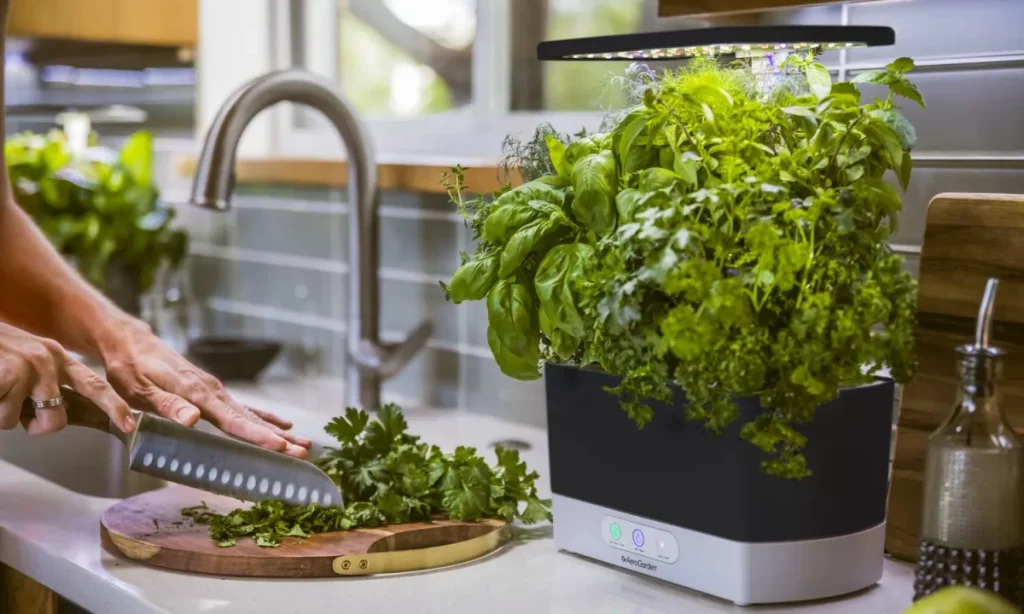
What Can You Realistically Grow?
The best crop for an indoor smart garden is usually the one that fits its height, pod spacing and reservoir — not the most ambitious picture on the packaging. Hydroponics still requires water, nutrients, light and enough root space. The RHS guide to hydroponics is a helpful introduction to the nutrient-based growing method behind many of these systems.
Herbs
Basil, parsley, coriander, chives, mint and smaller thyme or oregano plants are sensible starting crops for most indoor gardens. They can be harvested little and often, and they suit the compact height of countertop lights. Keep fast-growing herbs pruned so one plant does not shade its neighbours.
Leafy greens
Lettuce, salad leaves and some spinach-type greens are better matched to multi-pod gardens than fruiting plants. The Click & Grow 25 is specifically positioned for leafy greens, while the Smart Garden 9 can grow smaller batches. If you are choosing crops by speed and indoor suitability, see our guide to fastest-growing indoor vegetables.
Fruiting plants
Mini tomatoes, chillies and strawberries need more light, height, root room and often more attention to pruning or pollination than herbs. The LetPot LPH-Max has the most useful stated light-height allowance in this comparison, but even there, a manufacturer listing of fruiting crops is not a guarantee of an easy, heavy harvest. Avoid buying a two- or nine-pod countertop unit expecting it to replace a greenhouse.
Smart Features: Which Ones Actually Matter?
An automatic light schedule is useful on every model because consistent day/night timing removes one daily task. A low-water warning is helpful in a small-reservoir system such as the Exky SMART. App control becomes more valuable when it changes the garden itself — as with the LetPot’s stated schedule, light and cycling controls — rather than simply delivering care tips.
For a basic herb garden, passive watering may be the more useful “smart” choice. It avoids a pump and reduces the number of parts to clean. If light placement is your main concern, our grow-light guide for indoor gardening explains why plant distance and coverage still matter even when a garden includes LEDs.
Pods, Seeds and Ongoing Costs
Do not compare the purchase price alone. The ownership model differs sharply between these systems.
Click & Grow is partly proprietary: its pre-seeded Plant Pods are the simplest route and contain the growing medium and nutrition for the crop, but Grow Anything pods give you a way to sow your own seeds within Click & Grow’s format. You still need the brand-compatible pod system.
Véritable is strongly proprietary: the Exky SMART manufacturer specification says it is compatible with Véritable Lingots only. That can be convenient if you like the brand’s refill range, but it is a real limitation for a buyer who wants generic baskets, sponges or ordinary growing media.
LetPot is relatively open by comparison. You can use compatible grow sponges/baskets with your own seeds, but you must also buy and manage hydroponic nutrients and replace physical parts when they wear. There is no evidence in the current source material that any of these four systems requires a paid app subscription; that is different from saying there are no ongoing consumables.
Cleaning and Maintenance
None of these systems is maintenance-free. Top up water before a reservoir runs low, remove dead leaves and roots, harvest plants before they crowd neighbours, and clean the growing area between crops.
For a pumped garden such as the LetPot, reservoir hygiene and pump/filter cleaning matter because nutrient water and roots can leave debris behind. LetPot advises cleaning the pump and filter sponge after at least six months. Passive systems avoid that pump job, but still need tank cleaning. Véritable recommends cleaning its garden every 4–6 months when renewing Lingots; Click & Grow says its gardens are designed for easy cleaning, so follow the current model manual for removable parts and electrical safety.
Electricity and Power Use
The light is usually the main electrical load, and a pump adds some use in a recirculating system. Manufacturer figures are useful for comparison, but they do not give a universal household cost because your tariff and light schedule matter.
In this shortlist, Click & Grow states 13 W and 6.2 kWh per month for the Smart Garden 9, and 38 W and 18.24 kWh per month for the Click & Grow 25. Véritable states 7.5 W for the Exky SMART. LetPot states a 36 W light board for the LPH-Max but does not provide a comparable monthly kWh figure on the reviewed page. Use those differences to understand scale, then check the current product information rather than assuming any indoor garden uses negligible electricity.
Frequently Asked Questions
Are indoor smart gardens worth it?
They can be worth it if you value a clean, controlled way to grow herbs or salad leaves indoors and will use the harvest. They are less compelling if you expect a low-cost replacement for a full vegetable garden, or dislike buying pods/refills. Convenience, available space and ongoing consumables matter as much as the initial purchase.
What can I grow in an indoor smart garden?
Herbs and leafy greens are the most realistic place to start. Some systems offer mini tomatoes, chillies or strawberries, but those crops need more light, height, room and care. Choose a model around your usual crop, not a single promotional image.
Can I use my own seeds?
It depends on the system. LetPot supports growing seeds in compatible new sponges. Click & Grow offers Grow Anything pods for own seeds. Véritable specifies Lingot-only compatibility for the Exky SMART, so it is the least flexible option here.
How often do indoor smart gardens need cleaning?
Refill and tidy plants as they grow, then clean the tank and growing parts between crops or when roots/debris accumulate. Véritable recommends 4–6 monthly cleaning around Lingot renewal, while LetPot advises pump/filter cleaning after at least six months. Always follow the current manual for your exact model.
Do indoor smart gardens use much electricity?
They use electricity for built-in LEDs and, in some systems, a pump. The smaller passive gardens use less stated power than a large 25-pod unit, but cost depends on your tariff and schedule. Compare verified wattage/kWh figures rather than relying on a general claim.
Keep Growing Indoors
Choose Containers That Suit Your Crops
If a self-contained smart garden feels too restrictive for the vegetables you want to grow, our guide to the best pots for indoor vegetables helps you match container size and depth to herbs, salad leaves, peppers and dwarf tomatoes.
Final Thoughts
The best indoor smart garden is the one that matches the scale of your routine. Choose the LetPot LPH-Max for the widest capability and more hands-on hydroponic control, the Click & Grow Smart Garden 9 for a simple countertop starting point, the Exky SMART for two plants in a very small space, or the Click & Grow 25 for a larger leafy-greens setup.
Before buying, check the exact current bundle, compatible refills, plug and space requirements. A smaller garden that you refill, clean and harvest regularly is more useful than a feature-heavy system that does not fit your kitchen or your habits.
Related Articles
LEVEL UP YOUR INDOOR GARDEN SETUP
Turn Any Space into a Simple Smart Plant System
Once you’ve chosen the best indoor smart garden, you can expand your setup with a few smart add-ons. Learn how to combine timers, plugs, and basic sensors to create a DIY smart plant system that saves time and keeps your plants growing smoothly.