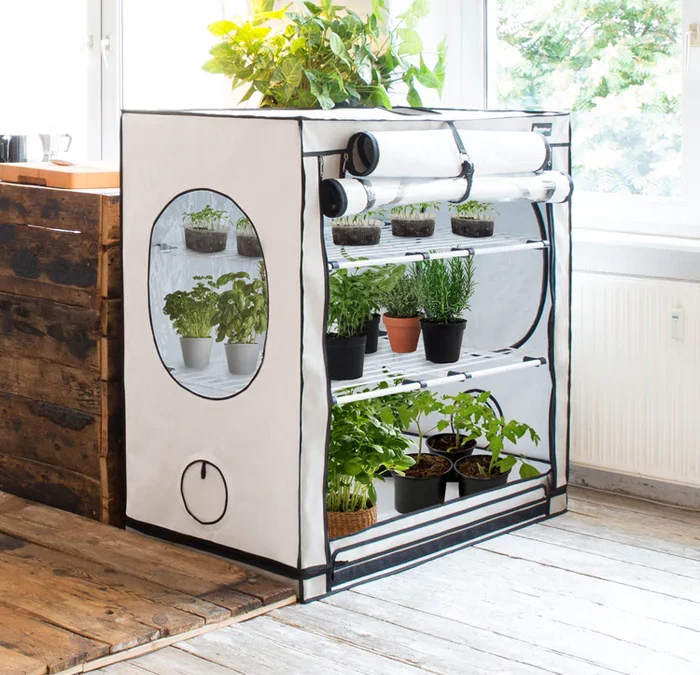
A grow tent gives indoor plants a defined space for grow lights, airflow equipment and day-to-day care. It can contain much of the stray light from a strong lamp, provide secure points for hanging suitable equipment and make a bedroom, spare room or garage setup easier to organise.
The tent does not control temperature or humidity on its own. A useful setup still needs a correctly sized light, a way to remove excess heat and moisture, safe cable routing and enough room around the plants. The four tents below cover genuinely different footprints, from a compact 60 cm model to a 120 cm larger setup.
Quick Answer
- Best Overall: Spider Farmer V3 Upgraded 90 × 90 × 180 cm 1680D Grow Tent — a useful balance of floor area, height, documented load capacity and current UK availability.
- Best Small Grow Tent: Secret Jardin Dark Street DS60 R4.00 — the smallest footprint here, with a well-documented modular ventilation system.
- Best Budget Choice: Mars Hydro 70 × 70 × 160 cm 1680D Grow Tent — the lowest-priced shortlisted model in the research snapshot, with a viewing window, removable tray and exact manufacturer SKU.
- Best Larger Setup: AC Infinity CLOUDLAB 844 — a 120 × 120 × 200 cm tent with 22 mm poles, extensive duct provision and the strongest stated beam capacity in this comparison.
Do This First
Measure more than the empty corner where the tent will stand. Check:
- available floor space, including room to open the door and reach the plants;
- ceiling height and clearance above the tent;
- pot or reservoir height and the plants’ likely mature height and spread;
- the depth of the grow light and its required distance above the canopy;
- space for an inline fan, filter and ducting if your setup needs them;
- the position of safe power sockets and a route that keeps cables away from water.
Buying by tent dimensions alone can leave a setup too cramped once pots, lights, fans and ducting are installed. If you have not chosen a light yet, use the Indoor Plant Grow Light Guide before deciding how much tent area you can use effectively.
Best Grow Tents for Indoor Plants Compared
On smaller screens: scroll sideways to view the full table.
| Model | Best for | Size | Material / frame | Ventilation | Main advantage | Main drawback |
|---|---|---|---|---|---|---|
| Spider Farmer V3 Upgraded 1680D | Best Overall | 90 × 90 × 180 cm | 1680D Oxford / 16 mm steel | Multiple duct ports; 4-inch fan recommended | Good middle-size balance with viewing window and 50 kg stated load rating | Exact port count is not clear in the official text specification |
| Secret Jardin Dark Street DS60 R4.00 | Best Small Grow Tent | 60 × 60 × 158 cm | M210D Mylar canvas / 16 mm Q195 steel | Two DF16 support flanges with configurable parts | Compact footprint and unusually detailed official accessory/load specification | Low height and no officially listed observation window |
| Mars Hydro MH-70X70X160 | Best Compact Value | 70 × 70 × 160 cm | 1680D Oxford / metal frame | Two 6-inch and one 8-inch port | Strong feature set for the lowest checked shortlisted price | Limited vertical space; pole diameter and separate cable-port count are unclear |
| AC Infinity CLOUDLAB 844 | Best Larger Setup | 120 × 120 × 200 cm | 2000D Oxford / 22 mm steel | Four 4-inch and five 8-inch ports | Most room, strongest stated beam capacity and largest viewing window here | Expensive, space-hungry and requires a larger supporting setup |
Specifications describe the tent shell, not a complete controlled environment. Prices and stock change, so they are deliberately not included in the article body.
1. Spider Farmer V3 Upgraded 90 × 90 × 180 cm 1680D — Best Overall
Why It Stands Out
The Spider Farmer is the strongest all-round choice in this comparison because its 90 cm square footprint gives more working room than the two compact tents without making the jump to a 120 cm square setup. Its current manufacturer specification lists 1680D Oxford fabric, a steel frame, a removable floor tray, an enlarged viewing window and a 50 kg load rating.
That combination makes it better suited to a mixed setup of houseplants, herbs, seedlings or compact vegetables where you want enough space to arrange pots and circulation equipment without filling most of a spare room.
Size and Build
The tent measures 90 × 90 × 180 cm. Spider Farmer lists 16 mm steel poles and a 1680D Oxford shell with a reflective Mylar lining. The observation window measures 40 × 30 cm on the outside and 35 × 25 cm internally, so plants can be checked without unzipping the whole door.
The manufacturer states a 50 kg load capacity. That is useful headroom for suitable lights and ventilation equipment, but it should not be treated as permission to place the full load on one bar. Follow the supplied assembly and hanging instructions and use the lowest limit of every hook, ratchet and support in the chain.
Ventilation and Access
Spider Farmer recommends a 4-inch inline fan and shows several duct openings, a side-access RJ12 controller port and an extra cable port. The current text specification does not give a dependable count and diameter for every opening, so check the product diagrams against the exact fan and duct route you plan to use.
The conventional main door and viewing window provide straightforward front access. Leave enough clearance outside the tent for the zip panel to open fully and avoid pressing a duct tightly against the wall.
Who It Suits
Choose it if you want a first serious indoor grow tent with more flexibility than a 60–70 cm model, but a 120 cm square tent would take over the room. It is a sensible fit for a small mixed plant collection, a deliberate seedling-to-mature setup or compact edible plants under a light matched to the 90 cm footprint.
Who Should Skip It
Skip it if you only need a small seedling or herb area, cannot leave working space around a 90 cm-deep tent, or already know that your mature plants and equipment need a 120 cm footprint. Also check the warranty before buying: Spider Farmer’s product page shows a generic five-year badge, while its current warranty policy says grow tents receive one year.
For the tent-only 1680D version, check the Spider Farmer V3 Upgraded 90 × 90 × 180 cm Grow Tent on Amazon.
2. Secret Jardin Dark Street DS60 R4.00 — Best Small Grow Tent
Why It Stands Out
The DS60 is the most space-efficient final choice. Its 60 × 60 cm floor area can fit where a 90 cm tent cannot, and Secret Jardin publishes clear information about the 16 mm frame, removable tray, modular DF16 flange system and hanging limits.
Unlike a basic shell with fixed fabric socks, the Dark Street uses configurable flange components. That is helpful when you want to plan the intake and exhaust positions, although it does add a little more assembly thought.
Size and Build
The DS60 measures 60 × 60 × 158 cm. Secret Jardin specifies M210D Mylar canvas, a PE600D base and 16 mm Q195 chrome-plated steel poles with polypropylene corner pieces. An internal WebIT plant support and removable WTL60 water tray are included.
The official sheet lists 10 kg per handling pole and 20 kg per tent. These are lower limits than those stated for the larger Spider Farmer and CLOUDLAB models, so add up the weight of the light, fan, filter and hanging hardware before installation.
Ventilation and Access
Two DF16 flange supports are included. The DS60 data lists two 100 mm connectors, one light baffle and one CF7 cable flange, allowing a compact intake/exhaust arrangement without leaving large unused holes open. Secret Jardin also includes cable-management accessories.
The data sheet does not list an observation window, so plan to use the main zip access when checking plants. That makes tidy front clearance important.
Who It Suits
Choose the DS60 for seedlings, herbs, smaller houseplants, propagation or another compact setup where a 60 cm footprint matters more than generous standing height. It can also suit a bedroom or utility room where a larger black tent would be intrusive.
Who Should Skip It
Skip it for tall plants or bulky hydroponic reservoirs. Once a pot, light and safe light-to-canopy gap are allowed for, 158 cm of external height can feel restrictive. It is also not the best choice if you want a large observation window or prefer simple fixed duct socks over modular flange components.
Make sure the listing says DS60 Rev 4, then check the Secret Jardin Dark Street DS60 R4.00 on Amazon.
3. Mars Hydro 70 × 70 × 160 cm 1680D — Best Compact Value
Why It Stands Out
The Mars Hydro is the budget choice because it was the lowest-priced final tent in the checked UK snapshot while still offering a manufacturer-backed SKU, 1680D Oxford fabric, a metal frame, a viewing window and a removable tray. Its 70 cm square footprint gives a little more usable floor than a 60 cm tent without needing the room demanded by a 90 cm model.
The value case comes from the documented essentials rather than a long accessory list. It is a simple shell for someone willing to plan a compact light and airflow arrangement carefully.
Size and Build
The exact model is SKU MH-70X70X160 and measures 70 × 70 × 160 cm. Mars Hydro lists a 1680D Oxford exterior, reflective Mylar interior, metal frame, reinforced corners, one front door and a 25 × 25 cm viewing/mesh window.
Official Mars Hydro records disagree slightly on the maximum load: one lists 55 kg and the EU wholesale sheet lists 50 kg. Use the lower 50 kg figure unless the exact supplied revision confirms otherwise. The current official specification does not state the pole diameter.
Ventilation and Access
The tent has two 6-inch ports and one 8-inch port, while Mars Hydro recommends a 4-inch inline fan. That is not necessarily a problem, but it means the ducting, reducers and closures need to fit the actual openings rather than being assumed from the fan size.
One front door and one viewing window keep access straightforward. A separate cable-port count is not clear in the current official specification; manually confirm the cable grommet shown in the expected listing before purchase.
Who It Suits
Choose it for a price-conscious first setup, a compact group of herbs or houseplants, seedlings, or smaller vegetables under a light that covers 70 × 70 cm effectively. It is also a practical middle ground when 60 cm feels tight but 90 cm will not fit.
Who Should Skip It
Skip it if you expect tall plants, want to place a large filter above the light, or need access from more than the front. The 160 cm height leaves less room for mistakes in the vertical plan, and the warranty period for the standalone tent was not clearly stated in the inspected manufacturer record.
Confirm the 70 × 70 × 160 cm 1680D tent-only variant, then check the Mars Hydro MH-70X70X160 Grow Tent on Amazon.
4. AC Infinity CLOUDLAB 844 — Best Larger Setup
Why It Stands Out
The CLOUDLAB 844 is the larger-setup choice for readers who genuinely need a 120 cm square growing area and have the light, ventilation and room to use it. AC Infinity lists 22 mm steel poles, 2000D Oxford canvas, a large 35 × 120 cm observation window, nine duct openings and a 250 lb (about 113 kg) beam capacity.
Those specifications give it the most substantial frame and port provision in this comparison. The advantage is flexibility, not automatic environmental control: a bigger enclosed area still needs correctly sized equipment and a sensible room layout.
Size and Build
The exact model is AC-CBA844 and measures 120 × 120 × 200 cm. It uses a 2000D Oxford outer shell, reflective diamond Mylar interior, 22 mm steel poles and three hanging bars plus one extra. A heavy-duty removable catch tray and controller mounting plate are included.
The 250 lb beam figure is a total manufacturer rating. Distribute equipment as the manual shows, use properly rated hangers and never assume one bar or corner can take the whole figure.
Ventilation and Access
Four 4-inch ports and five 8-inch ports provide several ways to route extraction, intake and other equipment. The dedicated controller plate includes a light-blocking cable passthrough. Check the official port-location plan before placing the tent, because a port facing a wall is much less useful once ducting needs room to bend.
The large observation window is useful for checking a broad canopy without opening the main zip. Allow access around the shell rather than squeezing the 120 cm tent exactly between furniture.
Who It Suits
Choose it for a larger spare-room or garage setup, broad groups of plants, larger hydroponic equipment or taller crops where 200 cm height and a strong overhead frame are genuinely useful. It is also the better final choice if you expect the setup to grow beyond a compact beginner tent.
Who Should Skip It
Skip it if you do not have at least 1.44 m² of clear floor plus working space, if your light only covers a small area, or if fan noise and equipment cost need to stay modest. UK buyers should also confirm the seller’s warranty route: AC Infinity states a two-year product warranty, but its prepaid return-label provision is for US addresses.
Confirm model AC-CBA844 rather than another CLOUDLAB size, then check the AC Infinity CLOUDLAB 844 on Amazon.
What Size Grow Tent Do You Need?
Start with the plant and equipment plan, then work backwards to the tent.
A 60–70 cm square tent can be useful for seed trays, herbs, compact foliage plants or one carefully planned small edible setup. A 90 cm square tent offers more room for pot spacing, circulation and access. A 120 cm square tent can support a broader layout, but only if the room, light coverage and extraction capacity increase with it.
The stated number of plants is a poor shortcut because ten seedling cells, four small herbs and one broad mature houseplant use space very differently. Check:
- the widest part of each mature plant, not just the pot;
- whether leaves will touch the walls or block access;
- how much floor area the fan, humidifier, reservoir or supports need;
- whether you can remove a pot without dismantling the setup;
- how far the lamp must sit from the canopy;
- where the fan/filter and ducting will go.
Height is often the hidden limit. Subtract the pot or reservoir, hanging hardware, light thickness and the light maker’s required clearance from the tent height. The remainder is the realistic space for stems and foliage.
Fabric, Frame and Zips
Fabric denier can be useful within one brand’s range, but it is not a complete quality score. A high number does not guarantee good stitching, light control or zip alignment, and M210D Mylar canvas is not directly comparable with 1680D or 2000D Oxford marketing.
Look for a shell that fits tightly over the frame without distorted seams, zip flaps that close cleanly, reinforced hanging points and ports that can cinch around the intended duct. A small amount of pinhole light is less important for ordinary houseplants than a zip that snags every day or a frame that cannot safely hold the equipment.
Steel pole diameter and official hanging limits matter when a light, fan or filter will be overhead. Use the manufacturer’s total and per-bar guidance, and remember that hooks, ratchets and brackets each have their own limits.
Ventilation and Airflow
A tent needs two related types of airflow:
- Air exchange removes excess heat and moisture and replaces stale air.
- Internal circulation reduces still pockets around leaves without blasting them with a strong fan.
A common layout places extraction high in the tent, an intake lower down and a small circulation fan where it moves air past rather than directly into the foliage. Port position matters because warm air rises and duct bends restrict airflow. Filters, long ducts, grilles and light baffles also reduce the real flow compared with a fan’s unobstructed headline rating.
Secret Jardin’s grow-tent ventilation guidance recommends arranging intake and exhaust so air moves through the space and warns that running extraction without an open intake can pull the tent shell inward. For more on gentle movement around leaves, see air circulation for indoor plants.
Not every legal houseplant or seedling setup needs a carbon filter. It adds resistance and should solve a real odour or filtration need rather than being treated as an automatic part of every tent.
Grow Lights Inside a Tent
Choose a light by its useful coverage and the needs of the plants, not by whether it physically fits between the walls. The RHS guide to artificial lighting for indoor plants explains where extra light can help, including seedlings, edible plants and dark or windowless rooms.
Use the exact light manufacturer’s hanging-distance guidance. Reflective walls can redirect stray light, but they do not make a weak lamp cover a large tent or make an over-close lamp safe. Leave room to raise the light as plants grow and check for both stretching from insufficient light and pale, curled or heat-stressed foliage from an unsuitable setup.
The driver and fixture also add heat. Keep required clearances, mount every part securely and place a remote driver outside the tent only when the manufacturer permits it. The Grow Light Placement guide gives more practical help with distance and coverage.
Humidity and Temperature
A zipped tent can trap water vapour after watering and heat from the light, especially when plants are crowded. It does not contain a thermostat or dehumidifier unless you add and control that equipment.
Place a suitable thermometer/hygrometer near canopy level rather than on the floor or directly in a fan stream. Look for trends after the light turns on, after watering and overnight. If conditions keep drifting too warm or damp, improve extraction, reduce crowding, reconsider the light’s heat load or change the room conditions. Simply opening the door is a temporary response, not a complete plan for a recurring problem.
Different houseplants, seedlings and vegetables prefer different conditions, so avoid one universal target. Use the site’s guides to balance humidity for indoor plants and understand a sensible temperature range for indoor plants before automating a set point.
Electrical and Equipment Safety
Water, hanging equipment and several powered devices share a small space, so keep the setup simple and inspect it regularly.
- Keep plugs, extension connections, controllers and drivers above and away from the floor tray or any point where water can collect.
- Route cables so they cannot be pulled, trapped in a zip or become a trip hazard outside the tent.
- Use properly rated equipment according to its manufacturer’s instructions.
- Secure lights, fans and filters with suitable hardware and respect the lowest load limit in the full hanging system.
- Do not overload a wall socket, extension lead or adaptor, and do not connect one extension lead to another.
- Fully unwind a cable reel when its instructions require this for its rated load.
Electrical Safety First’s extension-lead guidance explains why the combined load and the lead’s marked rating matter. If you are unsure whether the socket or planned load is suitable, ask a registered electrician rather than modifying wiring yourself.
Are Grow Tents Worth It for Indoor Plants?
A grow tent can be worthwhile when it solves a real room or equipment problem.
Advantages include:
- containing much of the spill from strong grow lights;
- giving lights and suitable ventilation equipment a defined support structure;
- organising pots, trays, cables and monitoring equipment in one area;
- making airflow and environmental monitoring more deliberate;
- isolating a specialist setup from the rest of a room.
Disadvantages include:
- the cost of the tent and the light, fan, ducting and monitoring equipment around it;
- floor space and a large black enclosure in a living area;
- heat and humidity build-up when ventilation is inadequate;
- fan and airflow noise;
- more cables and hanging equipment to install safely;
- unnecessary complexity for a few shade-tolerant houseplants near a good window.
If the plants only need a modest light boost, an open shelf with a suitable lamp may be simpler. A tent makes more sense when light containment, equipment mounting or a dedicated growing area is important enough to justify the extra setup.
FAQs About Grow Tents for Indoor Plants
What Size Grow Tent Do I Need for Indoor Plants?
Measure the mature canopy, pots and equipment rather than choosing from plant count alone. A 60–70 cm tent suits compact setups, 90 cm gives more working room, and 120 cm is for a genuinely larger light and plant area. Always subtract pots, the light and its required clearance from the stated height.
Do Grow Tents Need Ventilation?
They need a deliberate way to exchange air and remove excess heat and moisture. That may involve powered extraction, passive intake and internal circulation, depending on the light, plants and room. Do not seal a lit, watered setup and assume the tent will regulate itself.
Can a Grow Tent Get Too Hot?
Yes. Grow lights, drivers, pumps and warm room air can raise the temperature inside a closed tent. Monitor conditions at canopy level and respond with suitable ventilation, equipment placement or room cooling rather than relying on the fabric to control heat.
Are Grow Tents Good for Houseplants?
They can be useful for light-hungry houseplants, propagation or a collection that needs a dedicated lighted area. They are often unnecessary for a few plants already growing well in suitable window light, and crowding humidity-loving plants together can create problems if airflow is poor.
Do You Need a Grow Light in a Grow Tent?
Usually, because the opaque shell blocks most natural room light when closed. The light still needs to match the plant and tent footprint. A reflective interior helps manage stray light but does not replace sufficient lamp output or correct placement.
Plan the Light Before the Tent
Build a Grow-Light Setup That Fits
Use the Indoor Plant Grow Light Guide to match the lamp, coverage and hanging plan to the plants before committing to a tent size.
Final Thoughts on the Best Grow Tents for Indoor Plants
The best grow tent is the one that leaves enough room for the plants, light, airflow equipment and safe access after everything is installed. The Spider Farmer 90 × 90 cm model is the strongest all-round choice here, the Secret Jardin DS60 suits the tightest footprint, the Mars Hydro 70 cm tent offers the clearest budget route, and the CLOUDLAB 844 is built for a genuinely larger setup. Measure first, verify the exact variant and plan the supporting equipment before buying the shell.
Related Articles
- Air Circulation for Indoor Plants
- Best Temperature Range for Indoor Plants
- Fastest Growing Indoor Vegetables
Make indoor growing easier to manage
Build a Simple Setup That Keeps Plants Steady
A grow tent is most useful when it removes guesswork — stable light, steady airflow, and humidity you can actually control. If you’re building an indoor setup that works all year (without constant tinkering), this page pulls the essentials together.