

Brown spots, white dust and mould-like growth do not all mean the same thing. A houseplant may have a fungal disease, but similar marks can come from bacteria, pests, hard-water deposits, fertiliser salts, excess moisture, sun scorch or physical damage. The safest fungal treatment for indoor plants starts with the symptom and its location—not a spray bottle.
Use this guide to narrow the possibilities, take a low-risk first action and decide when a labelled treatment or expert diagnosis is justified. If roots or the crown are soft and collapsing, skip straight to the root and crown rot section because that is a different problem from a mark on a leaf.
Quick Answer
Do not spray an indoor plant simply because it has a brown spot, a white coating or growth on its compost. First identify where the symptom is, what it feels and looks like, whether it is spreading, and what changed before it appeared.
If an infectious disease or pest seems plausible, separate the plant from close neighbours while you investigate. Check both sides of the leaves, stems, flowers, crown, roots and potting mix. Review moisture, drainage, airflow and recent watering, misting, feeding, repotting or pesticide use. Avoid unnecessary leaf-wetting and do not use a fungicide until the likely problem and the product label support it.
Do This First
- Find the exact location. Is the mark on the upper leaf, underside, edge, stem, flower, crown, roots or only the compost surface?
- Describe it without diagnosing it. Is it dusty, fuzzy, wet, soft, dry, crispy, circular, translucent, crusty or accompanied by insects, webbing or sticky residue?
- Check whether it is active. Photograph or mark the edge of a lesion and look for new symptoms over the next few days. Old damage remaining visible is not proof that the problem is still spreading.
- Review recent changes. Consider watering, misting, humidity, airflow, crowding, temperature, a new plant, repotting, fertiliser, pesticide and a sudden change in light.
- Check the root zone when the whole plant is declining. Wet compost plus yellowing or wilt calls for a root inspection, not another drink.
Is It Actually a Fungal Problem?
Sometimes—but visual clues overlap. University of Maryland Extension’s indoor-plant diagnostic guide lists water spots, sunburn, fungi and bacteria as possible causes of leaf spots. It also separates powdery growth, grey mould, pest stippling and root rot because each needs a different response.
Start with these distinctions:
- Growth on the surface is more suggestive of mildew or mould than a colour change inside the tissue, but residue and pests can also sit on the surface.
- Wet, translucent or mushy tissue raises concern about bacterial disease or soft rot; it is not a reason to assume a fungicide will help.
- Dry brown edges more often point towards watering stress, salts, dry heat or root damage than a leaf fungus.
- A white crust on a pot rim, compost or leaf can be a mineral or fertiliser deposit. It is normally hard or chalky rather than fuzzy.
- Webbing, sticky residue, cottony clumps or visible insects point towards pests or their by-products.
- Fuzzy grey growth on dying flowers or leaves fits Botrytis more closely than powdery mildew.
- White or grey growth only on damp compost is often saprophytic surface growth, not a disease inside the plant.
Home inspection can narrow the possibilities, but it cannot identify every pathogen. When a valuable plant is deteriorating quickly, lesions are wet or collapsing, or several plants are affected, seek a diagnosis from a reputable horticultural adviser or plant clinic before applying a pesticide.
Quick Symptom Identification Table
On smaller screens: scroll sideways to view the full table.
| What you see | Possible cause | What to check | First action | When treatment may be needed |
|---|---|---|---|---|
| White dusty patches on leaves or stems | Powdery mildew; hard-water or spray residue | Is it spreading in irregular colonies? Is it on several leaves? Does it look chalky rather than fuzzy? | Isolate if spreading, remove severely affected leaves and improve spacing | Only after reasonable identification; use a product labelled for that plant, disease and setting if non-chemical steps are insufficient |
| Grey fuzzy growth | Botrytis/grey mould; mould colonising already dead tissue | Check ageing flowers, damaged leaves, cool humid conditions and prolonged wetness | Carefully bag/remove affected material and reduce crowding and leaf wetness | UK home-gardener options are limited; check current authoritative guidance rather than substituting a generic fungicide |
| Brown or black leaf spots | Fungal or bacterial leaf spot; scorch; water/chemical injury; physical damage | Look at both leaf surfaces, margins, newest growth and whether new spots are appearing | Separate if contagious disease is plausible, stop splash watering and monitor | Diagnosis matters before any chemical treatment, especially for wet, angular or collapsing lesions |
| Wet, translucent, angular or mushy spots | Bacterial disease; oedema; chilling or water injury | Check for yellow margins, ooze, odour, vein-bounded shapes, cold exposure and excess moisture | Isolate, keep foliage dry and avoid handling healthy plants after the affected one | Escalate for diagnosis; a fungicide should not be assumed to work |
| White or grey growth on compost | Saprophytic fungi on damp organic matter | Confirm growth is limited to the surface; check debris, drying time and drainage | Remove dead debris, adjust watering and remove a thick surface mat if present | Do not spray the foliage; repot or investigate roots only if the mix stays saturated, smells sour or the plant is declining |
| Green film or crust on compost | Algae encouraged by a persistently moist surface | Check surface moisture, light, airflow and water infiltration | Let the surface dry as the plant allows and break up/remove a thick mat | No fungicide is normally needed |
| Yellowing, wilt and soft dark roots | Root or crown rot; oxygen-starved roots from saturated compost | Slide the plant out and inspect roots and the stem base; check trapped water | Separate it, stop routine watering and remove clearly rotten tissue if enough healthy plant remains | Severe crown collapse or mostly rotten roots may make disposal or propagation of healthy tissue safer than treatment |
| Brown crispy tips or edges | Drying stress, salt build-up, root damage, hot air or scorch | Check moisture pattern, radiator/sun exposure, white crust and fertiliser history | Correct the identified care issue; do not remove every partly green leaf | Fungicide is not indicated unless separate evidence of disease appears |
| White crust or spots that resemble residue | Hard-water calcium, fertiliser salts or dried spray | Check pot rim and compost for similar hard deposits; examine whether it is fuzzy or growing | Stop unnecessary spraying, review water/feed and gently clean a small area | No fungicide is needed for a mineral deposit |
| Webbing, sticky residue, stippling or cottony material | Spider mites, aphids, scale, whitefly or mealybugs | Use a hand lens; inspect undersides, leaf joints and stems for insects | Isolate and identify the pest before choosing control | Use pest-specific—not fungal—management if the evidence supports it |
Powdery Mildew
Powdery mildew usually appears as white, powdery patches on a leaf or stem surface. Small colonies may enlarge and join, and heavily affected young growth can become distorted. Different powdery mildew fungi infect different host ranges, so an affected plant does not mean every houseplant will respond in the same way.
Lookalikes include chalky hard-water marks, dried foliar spray and the white cottony material produced by mealybugs. Inspect leaf joints and undersides for insects, and check whether the white material forms spreading colonies across living tissue rather than separate droplets or crusts.
For a plausible mildew infection:
- give the plant space and suitable ventilation;
- avoid wetting the foliage unnecessarily while symptoms are active;
- remove individual leaves that are heavily coated, while retaining mostly green foliage where possible;
- clear fallen affected material;
- monitor for fresh colonies on new leaves.
University of Maryland Extension’s powdery mildew guidance says removal and environmental adjustment are often enough in home conditions. A registered treatment may be considered for severe, correctly identified disease, but it must be authorised and labelled for the plant, the problem and the intended setting.
For a more focused visual guide, see powdery mildew on indoor plants.
Leaf Spots
“Leaf spot” describes a symptom, not one guaranteed cause. Fungal spots may be tan, reddish-brown or black and roughly circular, sometimes merging into larger dead areas. Bacterial spots may also be brown or black, but are often water-soaked, soft, angular or bounded by veins. Both may develop yellow margins. Sun scorch, cold-water marks, pesticide injury and physical bruising can overlap with either.
At home, ask:
- Are new spots appearing, or are you looking at old stable damage?
- Are the lesions dry and papery, or wet and soft?
- Do they begin where leaves are splashed or touch wet glass?
- Are they limited to the side exposed to a window, radiator or spray?
- Is there ooze, a rotten smell or tissue collapse?
- Are pests visible on the underside?
While you investigate, separate the plant if disease is plausible, water the compost rather than splashing leaves, and avoid handling healthy plants immediately after the affected one. Remove dead or severely affected leaves with a clean tool, but do not strip a weak plant of useful green tissue. Clean the tool before using it on a healthy plant.
University of Maryland Extension distinguishes fungal leaf spots from bacterial leaf spots. If lesions are watery, rapidly collapsing, angular, oozing or associated with a rotten smell, diagnosis matters because a fungicide may be irrelevant. For severe or continuing symptoms, consult a plant clinic or qualified horticultural adviser.
Grey Mould / Botrytis
Grey mould, caused by Botrytis cinerea, is most convincing when fuzzy or dusty grey-brown growth develops on ageing flowers, wounded tissue, dying leaves or soft decaying areas. Wet foliage, high humidity, cool conditions, crowding and poor ventilation can allow it to spread quickly.
Take care when moving affected material because dry spores are easily disturbed:
- Separate the plant from close neighbours.
- Enclose affected flowers or leaves in a bag before or immediately after cutting where practical.
- Remove dead flowers, fallen leaves and other decaying material.
- Reduce prolonged leaf wetness and give the plant suitable space and ventilation.
- Clean tools before using them on another plant.
- Watch nearby plants for new fuzzy growth or soft lesions.
RHS grey-mould guidance prioritises hygiene, ventilation and reduced humidity and currently lists no fungicide approved for gardener use against grey mould. Do not replace that limitation with an unlabelled “general fungus” spray.
White Mould or Fungal Growth on Potting Mix
A white or grey layer on the compost surface is often a fungus feeding on damp organic material. A green film is more likely to be algae. Neither automatically means the plant has a disease in its leaves, stem or roots.
University of Maryland Extension explains that surface fungi and algae are not usually detrimental, although a thick mat may become crusty, interfere with water entering the mix and support nuisance insects such as fungus gnats.
Check the pot before acting:
- Is the growth only on the surface?
- Is dead plant material lying on the compost?
- Does the surface remain damp for long periods?
- Is water trapped inside a cover pot or saucer?
- Can water drain freely?
- Is the plant otherwise firm and growing, or is it yellowing and collapsing?
Remove dead debris. Let the surface dry to the degree appropriate for that plant, improve spacing and drainage, and lift off a thick mat with the uppermost layer of mix if needed. Do not automatically spray the foliage. The full guide to preventing mould in indoor soil covers recurring surface growth in more detail.
If the compost is saturated, smells sour and the plant is wilting or yellowing, inspect the roots. That combination is no longer just a cosmetic surface issue.
Root and Crown Rot
Root and crown rot must not be treated as another leaf fungus. Several water moulds, fungi and secondary microbes can be involved, while prolonged saturation can injure roots even before a specific pathogen is confirmed.
Above the compost, warning signs include yellowing, wilt despite wet soil, poor growth and collapse at the stem base. The decisive check is below the surface: healthy roots are generally firm, while rotted roots or crown tissue are brown to black, soft or mushy. A sour or stagnant smell can support the concern, but smell alone is not a diagnosis.
If enough healthy plant remains:
- Separate the plant and stop watering on autopilot.
- Remove it from the pot and assess how much firm root and crown tissue remains.
- Cut away clearly rotten portions with a clean tool, keeping as much healthy tissue as possible.
- Repot viable material in clean, suitable free-draining potting mix and a clean pot with working drainage.
- Correct trapped water, an oversized pot, dense mix or unsuitable watering before returning to normal care.
- If the crown is collapsing or few healthy roots remain, take cuttings only from firm, symptom-free tissue where that species can be propagated.
University of Maryland Extension’s root-rot guide recommends discarding severely infected plants and propagating only healthy tissue. The step-by-step root rot in houseplants guide explains the rescue process without treating the foliage.
Problems That Can Look Like Fungus
Pest Damage
Spider mites can cause fine pale stippling and may leave webbing. Aphids, scale, mealybugs and whiteflies can produce sticky honeydew; dark sooty mould may then grow on that residue. Cottony mealybugs can be mistaken for white fungus. Look for insects and shed skins with a hand lens before choosing a treatment.
Mineral Deposits
Hard-water calcium and dried spray droplets can leave pale or white marks on foliage. They tend to follow droplet patterns and look crusty rather than fuzzy. Similar hard deposits may appear on the pot rim or compost surface.
Fertiliser or Salt Damage
Excess soluble salts can contribute to brown tips, scorched margins, wilt and a white-grey crust on the compost or pot. Review how much fertiliser was used and whether water drains through the pot. A fungicide will not correct salt injury.
Oedema and Water-Related Spotting
Oedema is a physiological response in which roots take up water faster than leaves can release it. It can cause translucent spots that become rough or corky, often on lower leaf surfaces. Excess moisture, low light and cool conditions can contribute. Existing corky damage will not disappear, but correcting watering, drainage and light can stop new injury.
Sun Scorch, Cold and Physical Damage
Scorch often appears on the side facing intense sun or hot glass after a sudden move, while cold exposure can cause darkening or collapse. Rubbing, creasing and pruning injuries usually follow a contact point. If the mark remains stable and no new symptoms appear, an infectious disease becomes less likely.
Bacterial Disease
Water-soaked, angular, soft or foul-smelling lesions are warning signs for bacterial disease, especially when tissue collapses. Keep the plant separate, avoid wetting the foliage, clean tools and seek help with identification. Some systemic bacterial infections cannot be cured; a generic fungicide is not an appropriate fallback.
If dry brown margins are the main symptom, use the brown leaf tips guide to check water, salts, roots and heat before treating disease.
Step-by-Step: What to Do When You Find a Suspected Fungal Problem
- Inspect before treating. Record the location, texture, pattern and speed of change.
- Isolate when contagion is plausible. Give the plant space without putting it in unsuitable light or temperature.
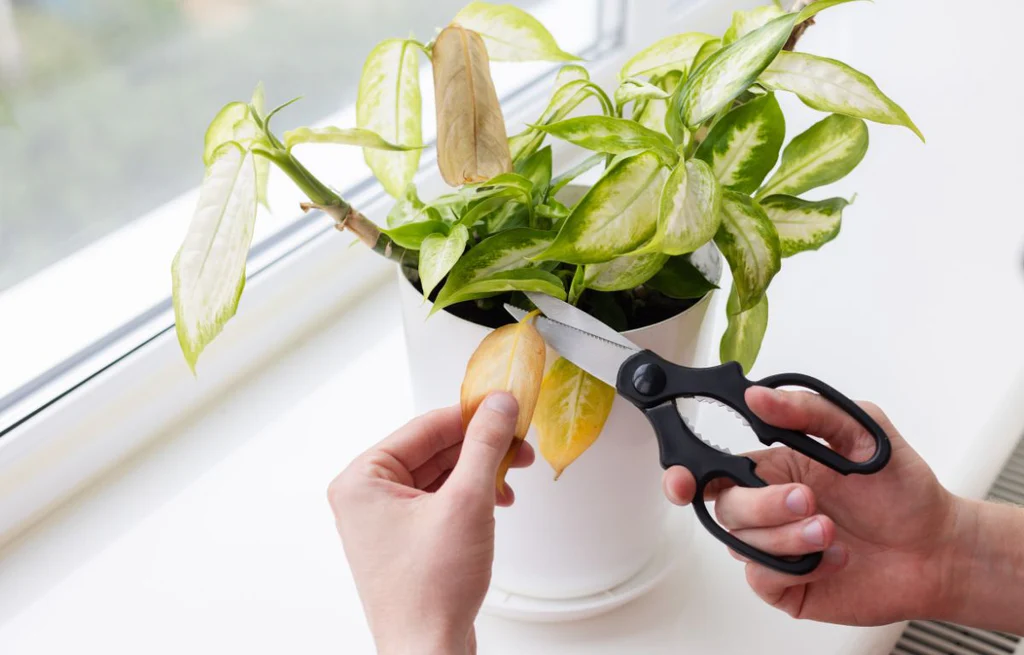
- Remove dead or heavily affected material. Bag obvious Botrytis growth carefully. Retain useful green tissue where possible.
- Check roots and pot moisture. Yellowing or wilt in wet compost requires a root-zone check.
- Reduce unnecessary leaf wetness. Water the compost without splashing and pause misting while a foliar disease is suspected.
- Improve spacing and gentle air movement. Do not blast the plant with a fan or expose it to a cold draught.
- Clean tools between affected and healthy plants. Also wash hands after handling suspicious material.
- Monitor new symptoms. Photograph the plant and look for new lesions or fresh growth. Dead tissue will not turn green again.
- Use treatment only when the diagnosis and label support it. The label—not a generic timetable—sets the plant, problem, setting, dose, precautions and repeat interval.
- Escalate or discard when necessary. Rapid collapse, severe crown/root rot or continuing spread despite appropriate intervention warrants expert advice or disposal.
When Should You Use a Fungicide?
Often, you should not. Cultural correction may be enough for mild powdery mildew or fungal leaf spots, and it is the main response to Botrytis risk, surface fungal growth and saturated compost. A fungicide will not fix pest injury, salts, oedema, scorch, bacterial disease or dead tissue.
A targeted treatment is reasonable only when:
- the problem has been identified with enough confidence to justify it;
- the product is currently authorised for amateur use in the UK;
- the label covers the plant or plant group, the disease and the intended indoor/home setting;
- non-chemical correction alone is unlikely to protect remaining healthy tissue;
- you can follow every precaution, application direction and repeat interval on the current label.
Fungicides are commonly better at protecting uninfected tissue or reducing new infection than reversing established damage. Brown, necrotic or collapsed tissue will not be repaired by spraying. More product or more frequent application is not automatically better and may damage the plant or create avoidable exposure.
The UK Health and Safety Executive advises checking that a plant-protection product is authorised and always following its label. Do not improvise doses or substitute baking soda, vinegar, milk, cinnamon, neem, copper or hydrogen peroxide as a universal treatment.
When Should You Throw the Plant Away?
Do not discard a plant for one stable spot or a little harmless surface mould. Disposal becomes proportionate when:
- most roots are soft, dark and rotten;
- the crown or stem base is extensively soft or collapsing;
- little firm, healthy tissue remains for recovery or propagation;
- a suspected systemic bacterial disease is causing continued collapse;
- symptoms keep progressing despite a credible diagnosis and appropriate intervention;
- the plant cannot be isolated and presents an unacceptable risk to valuable nearby plants.
Bag clearly diseased material before moving it through a plant collection. Do not propagate from spotted, soft or otherwise symptomatic tissue.
How to Prevent Fungal Problems Indoors
- Water according to the plant and the moisture in its root zone, not a fixed weekday.
- Use a pot and mix that drain properly, then empty standing water from saucers and cover pots.
- Give leaves and flowers enough space to dry after accidental wetting.
- Avoid unnecessary misting or splash watering, especially when disease is present.
- Remove spent flowers and dead plant material before it decays around healthy tissue.
- Clean cutting tools before moving between plants.
- Inspect new plants—including leaf undersides and roots—before placing them in a collection.
- Increase light gradually and keep plants away from damaging hot glass, radiators and cold draughts.
- Record what changed before a problem appeared so you can reverse the likely cause rather than changing everything at once.
If pots remain wet for too long, fix the root-zone setup with the guide to improving indoor plant drainage.
Common Mistakes
- Spraying before identifying the likely problem.
- Assuming every leaf spot is fungal.
- Keeping compost permanently wet while trying to “raise humidity”.
- Misting a plant that already has active leaf or flower lesions.
- Treating surface mould as proof of a systemic plant disease.
- Repeatedly applying homemade mixtures without evidence or label directions.
- Using a fungicide on webbing, sticky residue or visible insects.
- Leaving diseased fallen leaves or spent flowers in the pot.
- Using the same contaminated tool on affected and healthy plants.
- Removing nearly every leaf when only a few are severely affected.
- Assuming damaged spots will turn green after successful treatment.
- Repeating a product weekly because a generic article suggested it.
FAQs
How can I tell if a plant problem is fungal?
Look for a characteristic pattern—such as spreading powdery growth, fuzzy grey mould on dying tissue or enlarging dry lesions—but also inspect pests, residue, roots and environmental history. Appearance alone cannot identify every pathogen, so wet, collapsing or fast-spreading symptoms may need expert diagnosis.
Should I remove leaves with fungal spots?
Remove dead, heavily affected or collapsing leaves when disease is reasonably likely, and clean the tool afterwards. Keep mostly green leaves when practical because stripping a weak plant can slow recovery. Stable cosmetic spots do not always justify pruning.
Can fungal disease spread between houseplants?
Some diseases can spread through airborne spores, splashed water, infected debris, soil or contaminated tools. Others have narrow host ranges, and many fungus-like symptoms are not infectious at all. Temporary separation is a sensible precaution while an active disease is being assessed.
Is white mould on potting soil dangerous?
Surface fungal growth is usually feeding on damp organic matter rather than attacking the plant. It indicates that the surface stays moist and can form a crust or support fungus gnats. Correct the moisture and drainage; inspect roots only if the plant is also declining or the compost stays saturated.
Do I need fungicide for powdery mildew?
Not always. Removing heavily affected leaves, improving spacing and correcting the environment are often sufficient in a home. Consider a fungicide only for reasonably identified disease when a current product label specifically permits the plant, disease and setting.
Can overwatering cause fungal problems?
Persistently wet compost reduces oxygen around roots and raises the risk of root decline and some diseases. It can also encourage surface fungi and algae. Overwatering does not prove that a visible leaf mark is fungal, so check the roots and the symptom separately.
Will damaged leaves recover?
Dead, brown, corky or collapsed tissue will not turn green again. Successful action is shown by the absence of new symptoms and the production of healthy new growth, not by old damage disappearing.
Still Not Sure What You Are Seeing?
Rule Out Pests Before You Treat a Disease
Webbing, sticky leaves, cottony clumps or visible insects point away from a fungal diagnosis; compare the clues in the indoor plant pest guide before choosing a treatment.
Final Thoughts
The most useful fungal treatment for indoor plants is a correct first decision. Inspect the location and texture of the symptom, check whether it is changing, review recent care and examine the roots when the whole plant is declining. Separate genuinely suspicious plants, correct wetness and crowding, remove clearly diseased material carefully, and monitor new growth.
Use a fungicide only when the likely diagnosis and a current authorised label support it. A brown spot, white mark or damp compost surface is not enough evidence on its own.
Related Articles
STOP REPEATING THE SAME FUNGUS CYCLE
Make Your Indoor Setup Dry Faster and Stay Healthier
Fungal treatment for indoor plants works best when your routine prevents damp leaves and stale air. A simple airflow-and-watering setup makes outbreaks less likely, so you’re not constantly cutting leaves off.