If your indoor plants look leggy, pale, or “stuck”, it’s often not your compost or fertiliser — it’s the light. Understanding the role of artificial lighting in indoor gardens helps you grow stronger leaves, tighter growth, and better harvests (even in darker UK months).
In this updated article, you’ll learn what artificial light actually does for plants, the easiest ways to use it at home, and how to avoid common mistakes. For choosing the right type of grow light, you can also read Best Lights for Indoor Gardening.
Contents
- 0.1 The Role of Artificial Lighting in Indoor Gardens
- 0.2 Which Indoor Plants Benefit Most From Artificial Light?
- 0.3 How Long Should Grow Lights Be On?
- 0.4 How Far Should a Grow Light Be From Plants?
- 0.5 What “Spectrum” Means Without the Confusion
- 0.6 The Easiest Indoor Lighting Setups That Actually Work
- 0.7 Common Mistakes With Artificial Lighting Indoors
- 0.8 FAQs About Artificial Lighting in Indoor Gardens
- 0.9 Final Thoughts on The Role of Artificial Lighting in Indoor Gardens
- 0.10 Related Articles
- 1 Build a Simple Indoor Garden Routine That Works
The Role of Artificial Lighting in Indoor Gardens
Plants don’t “want” bright light because it looks nice — they need enough usable light to photosynthesise (make energy). Indoors, natural light is often reduced by:
Short winter days
Cloud cover
Window direction (north-facing rooms are common light-traps)
Distance from the window (light drops fast the further back you go)
Artificial lighting helps by doing one or more of these jobs:
1) Extending the day
Even if your plant gets some daylight, artificial light can extend the “day length” so growth doesn’t slow to a crawl.
2) Boosting intensity
A plant might be near a window but still not get enough intensity to grow well (especially for herbs and anything you want to flower or fruit).
3) Improving consistency
Indoor light can be patchy — bright at midday, dim in the morning, and dark by mid-afternoon. Artificial lighting can smooth that out so plants get a steadier routine.
Which Indoor Plants Benefit Most From Artificial Light?
You’ll see the biggest difference with plants that either grow quickly or need stronger light to stay compact:
Herbs and edible leaves
Basil, coriander, parsley, salad leaves and microgreens are much more reliable with a consistent light top-up.
Fruit and veg indoors
Chillies, dwarf tomatoes, and dwarf citrus often need more than a windowsill can provide for strong growth and fruiting.
“Low light” houseplants that look a bit sad
Snake plants and pothos may survive in low light, but artificial lighting can improve leaf colour and reduce stretched growth.
If you’re trying to grow food indoors, artificial light is usually the difference between “alive” and “productive”.
How Long Should Grow Lights Be On?
This is where people either underdo it (plants stay weak) or overdo it (no dark period).
A simple starting point most beginners can follow:
Low-light houseplants: 8–10 hours
Herbs and leafy greens: 10–14 hours
Fruiting plants (chillies/tomatoes/citrus): 12–16 hours
If your plants also get decent daylight, you can lean toward the lower end. If your plants get very little natural light, you’ll need longer.
To keep it effortless, a plug-in timer for grow lights stops you forgetting and keeps plants on a consistent routine.
How Far Should a Grow Light Be From Plants?
Distance matters more than most people expect. If the light is too far away, it becomes a nice room lamp rather than a plant-growing tool.
A practical approach at home:
Start with the light close enough to make a difference (usually above the canopy, not across the room).
Watch your plants for 7–10 days and adjust.
Too far away looks like: stretching, leaning, pale new growth
Too close looks like: bleached patches, dry edges, stressed leaves
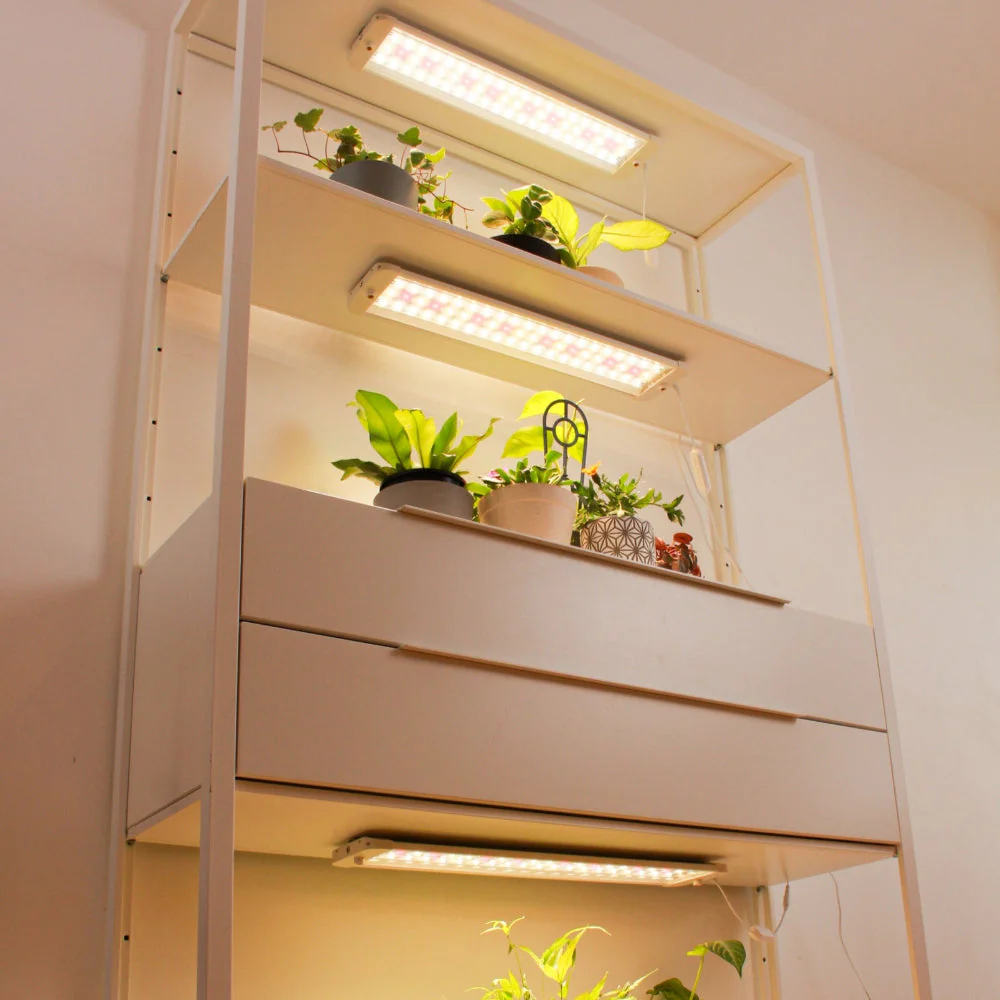
If you’ve got herbs on shelves or a grow station, a full-spectrum LED grow light bar for shelves is often easier than a bulky panel and gives more even coverage.
What “Spectrum” Means Without the Confusion
You’ll see words like “full-spectrum”, “blue”, “red”, and “PAR/PPFD”. Here’s the simple version:
Plants use light mainly in the blue and red ranges for growth and flowering.
“Full-spectrum” LEDs are designed to cover a useful range while looking more natural in a home.
You don’t need to obsess over the perfect spectrum for a basic indoor garden. For most homes, choosing a decent grow light and placing it properly matters far more than chasing technical numbers.
The Easiest Indoor Lighting Setups That Actually Work
Setup 1: Windowsill + light top-up
Great for: herbs, small leafy greens, low-light houseplants
Use natural light in the day
Add a grow light for a few hours in the evening
Keep the light above the plants (not behind them)
Setup 2: Shelf grow station
Great for: microgreens, herbs, propagation trays
Use an LED bar per shelf
Keep lights consistent with a timer
Rotate trays if one side grows faster
Setup 3: A “dark corner rescue” light
Great for: keeping a plant healthy where daylight is weak
Use a dedicated plant light to stop stretching
Keep it close enough to make an impact
Don’t expect heavy flowering or fruiting in truly dim rooms
Common Mistakes With Artificial Lighting Indoors
Leaving lights on 24/7
Plants need a dark period. Growth can become stressed and weird if you remove night completely.
Putting the light in the wrong place
A light across the room won’t help. The light needs to be above and reasonably close to the plant canopy.
Watering like it’s summer
Under better light, plants may drink more — but in winter and cooler rooms, compost can still stay wet. Always check the soil rather than watering on a strict schedule.
Expecting low light plants to behave like sun-lovers
Artificial light helps, but it can’t always turn a dim room into a greenhouse. Start with realistic plant choices for your home.
FAQs About Artificial Lighting in Indoor Gardens
Do I need a grow light if my plants are on a sunny windowsill?
Not always. But in winter or for herbs and edible crops, a light top-up can keep growth steadier and reduce legginess.
Can normal LED bulbs work instead of grow lights?
They can help for very low-light houseplants if they’re bright and close enough, but dedicated grow lights are usually more effective for herbs and food plants.
Is it safe to leave grow lights on overnight?
It’s better to give plants a dark period. Aim for a consistent daily schedule and avoid running lights 24/7.
Why are my plants still leggy under a grow light?
Usually the light is too far away, too weak, or not on for long enough. Move it closer and increase hours slightly, then reassess after a week.
What’s the easiest way to automate my indoor lighting?
Use a simple timer so lights turn on and off at the same time every day.
Final Thoughts on The Role of Artificial Lighting in Indoor Gardens
Once you understand the role of artificial lighting in indoor gardens, it becomes much easier to troubleshoot weak growth. Light isn’t just “extra” — it’s the fuel that decides how compact, leafy, and productive your indoor plants can be.
Keep it simple: put the light above the plants, keep it close enough to matter, and run it on a steady schedule with a timer. Small changes in placement and consistency often make a bigger difference than buying more products.
Related Articles
MAKE YOUR INDOOR GARDEN MORE CONSISTENT
Build a Simple Indoor Garden Routine That Works
Artificial lighting helps, but the biggest results come when light, watering, and basic maintenance work together. If you want healthier plants with fewer surprises, set up a simple routine you can stick to in every season — especially through winter when indoor conditions change fast.