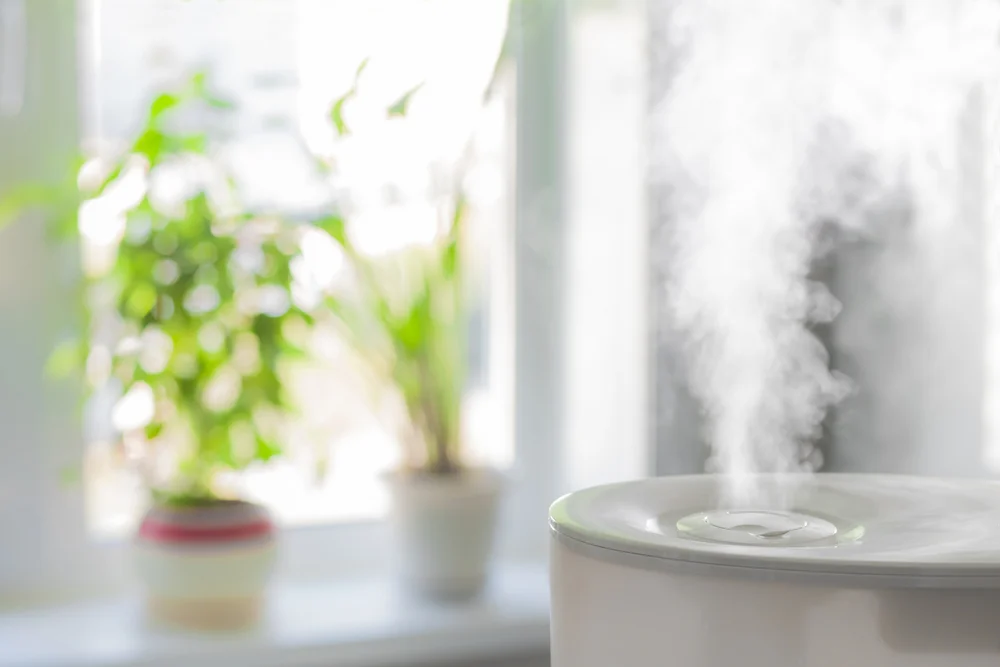
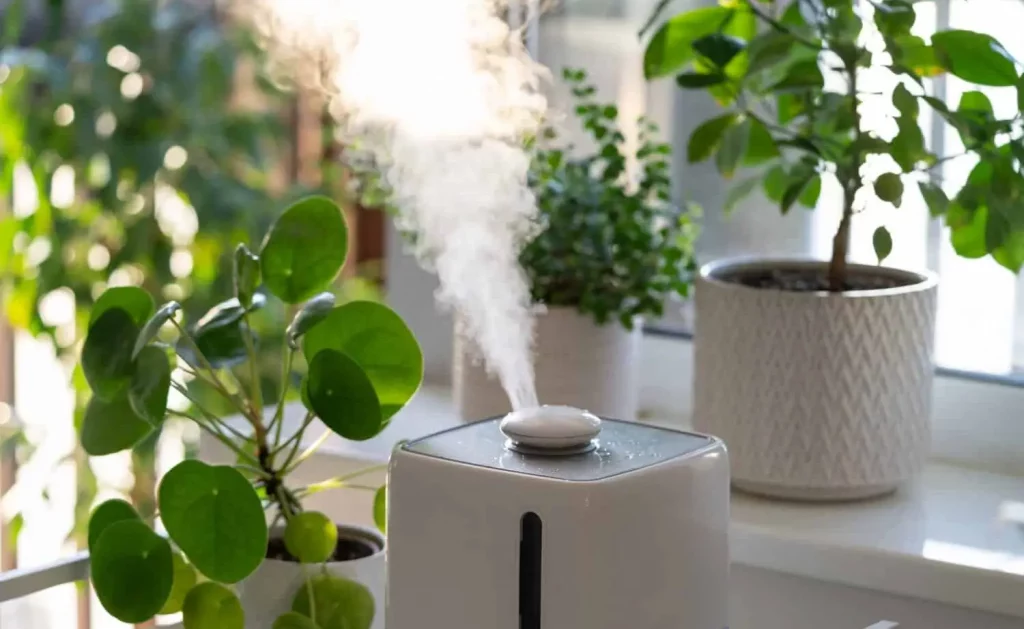
Smart humidifiers can be useful for indoor plants, but they are not an automatic upgrade for every collection. The useful question is whether the room is actually too dry for the plants you grow – especially during winter heating – rather than whether a humidifier looks good beside a plant shelf.
The models below are current, connected humidifiers with clearly different strengths: a larger warm/cool option, a more compact value choice, a simple app-controlled top-fill model and an evaporative alternative. The right choice depends on the size of the room, the plants in it and how much maintenance you are prepared to do.
Quick Answer
The Dreo Smart Humidifier 713S (HM713S) is the strongest overall choice in this comparison for a larger plant room or a mixed indoor collection. Its 6L tank, warm- and cool-mist modes, app control and high-precision humidity control give it the most flexible feature set of the models compared. The Dreo Smart Humidifier 311S (HM311S) is the better value option for a smaller or medium-sized room if you want app control, a 4L tank and a simpler cool-mist design. If you prefer an evaporative unit with no visible mist plume, the SwitchBot Evaporative Humidifier (Auto-refill) is the more specialised option, although its auto-refill feature requires extra SwitchBot equipment. Do this first: use a hygrometer in the area where your plants actually sit before buying anything. A smart humidifier is most useful when it solves a measured low-humidity problem, not when it is used to guess at one.Smart Humidifier Comparison for Indoor Plants
On smaller screens: scroll sideways to view the full table.
| Model | Best for | Tank | Smart control | Humidistat | Main advantage | Main drawback |
|---|---|---|---|---|---|---|
| Dreo Smart Humidifier 713S (HM713S) | Larger rooms and a mixed tropical-plant collection | 6L | Dreo app; voice control is listed by the retailer | +/-5% high-precision humidity control | Warm and cool mist, long runtime and strong feature set | Larger, more involved unit; cartridge and warm-mist running considerations |
| Dreo Smart Humidifier 311S (HM311S) | Value-focused smaller or medium rooms | 4L | App, touch and voice control | Auto Mode/humidity sensing; exact target-setting detail is not clearly stated on the manufacturer page | Compact top-fill design with a 300 sq ft maximum coverage | Cool mist only; less headroom than the 713S |
| Levoit OasisMist 450S Smart Humidifier | Best alternative / easy-to-use smart option | 4.5L | VeSync app | Auto Mode maintains the preferred humidity level set in VeSync | Warm and cool mist, high output and easy top filling | Filter-related care and replacement availability should be checked |
| SwitchBot Evaporative Humidifier (Auto-refill) | People who prefer evaporative humidity and SwitchBot automation | 4.5L | SwitchBot app/voice ecosystem | Automation is available with compatible SwitchBot sensors/hubs; target-setting detail is not clearly stated | Cold evaporation and a very low stated minimum noise level | Auto-refill needs a SwitchBot S10 and there is an evaporative filter to maintain |
How These Models Were Chosen
Unless stated otherwise, these recommendations are based on product specifications, current availability and publicly available product information rather than personal hands-on testing. The shortlist focuses on current models with a credible UK buying route, a practical tank size and maintenance approach, and a meaningful form of humidity sensing or connected control. It also avoids simply recommending the same type of humidifier in different colours. Manufacturer claims such as runtime, room coverage and noise are useful for comparing models, but they are not guarantees for every home. A drafty room, central heating, open doors, hard water and the chosen output level can all change real-world results. Check the latest product page, manual and retailer listing before you buy.Best Overall: Dreo Smart Humidifier 713S (HM713S)
Verdict
Choose the Dreo 713S if you want one humidifier to cover a larger plant room, have several humidity-sensitive plants together or want the flexibility of warm and cool mist. It has the largest tank in this comparison at 6L, up to 60 hours runtime according to Dreo and a +/-5% high-precision humidity control feature. For a plant owner, the useful part is not the word “smart” on its own. The useful part is being able to monitor and adjust humidity more deliberately than with a basic on/off unit. A larger tank can also mean fewer refills when the air is dry, although that will vary with output level and conditions. Pros- 6L top-fill tank gives the most refill capacity of these four models.
- Warm- and cool-mist modes make it more flexible across seasons and rooms.
- Dreo lists app control, scheduling and automatic humidity control features.
- Dreo lists up to 60 hours runtime and an effective range of 20-40 m2 in its FAQ.
- Low-water automatic shut-off is listed, which is useful if you run it near a plant collection.
- It is a more substantial appliance than the 4L alternatives, so measure the surface before buying.
- Warm mist and high-output use can increase electricity use compared with a simple cool-mist unit.
- Dreo’s documentation refers to a replacement cartridge for reducing white dust in some water conditions, so check ongoing consumable availability.
Best Value: Dreo Smart Humidifier 311S (HM311S)
Verdict
The Dreo 311S is the sensible lower-capacity choice when you want connected control without stepping up to a larger warm/cool humidifier. It has a 4L tank, cool-mist operation, top filling and a 300 sq ft maximum coverage with up to 32 hours runtime according to Dreo. That makes it a better fit for a bedroom, study or modest plant corner than for a large open-plan space. Its Auto Mode and humidity sensing are useful, but the manufacturer page does not clearly state a user-selectable target-humidity range, so confirm that detail if precise setpoint control is your deciding factor. Pros- 4L capacity is practical without making the unit as bulky as the 713S.
- Top-fill, modular construction and a supplied cleaning brush should make routine cleaning easier.
- Dreo lists app, touch and voice-control options.
- Manufacturer lists 28 dB noise and automatic shut-off when the tank is empty.
- Cool mist only, so it does not offer the warm-mist flexibility of the 713S.
- Its lower coverage makes it less suitable for a large open room.
- Exact target-humidity setting details are not clearly stated on the manufacturer product page.
Best Alternative: Levoit OasisMist 450S Smart Humidifier
Verdict
The Levoit OasisMist 450S is the easy-to-use smart alternative if you want warm and cool mist without moving to a larger 6L model. Levoit lists a 4.5L tank, VeSync app control, Auto Mode with a preferred humidity level, up to 45 hours on low cool mist and a maximum 550 mL/hour output. Its dual adjustable 360-degree nozzles can be useful when you want humidity to disperse around a plant grouping rather than aim a stream at one leaf. Keep the humidifier away from foliage and furniture rather than directing output straight at the plants. Pros- 4.5L tank sits between the two Dreo capacities.
- VeSync app control, schedules, timers and Auto Mode with a preferred humidity level.
- Warm and cool mist gives it more seasonal flexibility than a cool-mist-only model.
- Levoit lists up to 550 mL/hour output, up to 45 hours on low cool mist and coverage up to 40 m2.
- Top-fill construction and dual 360-degree nozzles make filling and directing output straightforward.
- Levoit lists automatic shut-off when the tank runs out of water and noise as low as 26 dB.
- The 40 m2 coverage figure is a useful guide, but room layout and conditions will still matter.
- Warm-mist use and the highest output settings may use more power and require more frequent refilling than low cool mist.
- The UK product page lists a service-filter indicator and carbon filter type, but a replacement SKU and interval are not clearly stated there; check current consumable availability before buying.
Best Evaporative Option: SwitchBot Evaporative Humidifier (Auto-refill)
Verdict
The SwitchBot Evaporative Humidifier is the most distinct choice in this comparison. Instead of a visible mist plume, it uses cold evaporation. SwitchBot lists a 4.5L tank, a recommended 20-30 m2 area, four output levels from 200 to 700 mL/hour and a runtime range of 6 to 22.5 hours depending on the setting. It is particularly interesting if you already use SwitchBot devices. The unit can work with the SwitchBot app and ecosystem, while sensor-led automation needs compatible SwitchBot Meter or Hub 2 hardware. Do not buy it expecting automatic refilling out of the box: that feature needs a SwitchBot S10 robot vacuum and is an optional system rather than a standard included function. Pros- Cold evaporation may appeal if you do not want a visible mist plume near plants or furnishings.
- 4.5L tank and a stated 20-30 m2 recommended area.
- SwitchBot lists a low minimum noise level of under 18 dB at level 1.
- App and smart-home ecosystem can be useful when paired with compatible SwitchBot sensors.
- It is physically larger and heavier than the compact ultrasonic-style alternatives.
- It uses an evaporative filter, so filter cleaning and replacement cost should be part of the decision.
- The headline auto-refill feature needs extra hardware and is not included with the humidifier alone.
Check the SwitchBot Evaporative Humidifier on Amazon for current availability and product details.
What to Look for in a Smart Humidifier for Indoor Plants
Start with the room, not the plant label
A humidifier changes the air in a space, not the humidity around one pot. Measure relative humidity where the plants live: a shelf by a radiator can be much drier than the middle of the room. If the reading is already stable and suitable for your plants, a humidifier may be unnecessary. As a broad household starting point, 40-60% relative humidity is often discussed as a practical indoor range. It is not a universal plant target. Plants from humid tropical habitats may appreciate a less dry environment, while many cacti and succulents do not need high humidity and can be more vulnerable to problems if conditions stay damp with poor airflow. For a plant-specific perspective, Penn State Extension’s guidance on humidity and houseplants is a useful reminder that one target does not suit every plant.Choose a tank size that matches your routine
Tank size is mainly a refill-convenience question. A 4L or 4.5L unit can be enough for a smaller room or moderate use. A 6L model may be easier to live with when central heating is running or you are trying to support a larger collection. Published runtimes are always “up to” figures; higher output means more frequent filling.Treat humidity control as a monitoring tool, not an instruction to maximise moisture
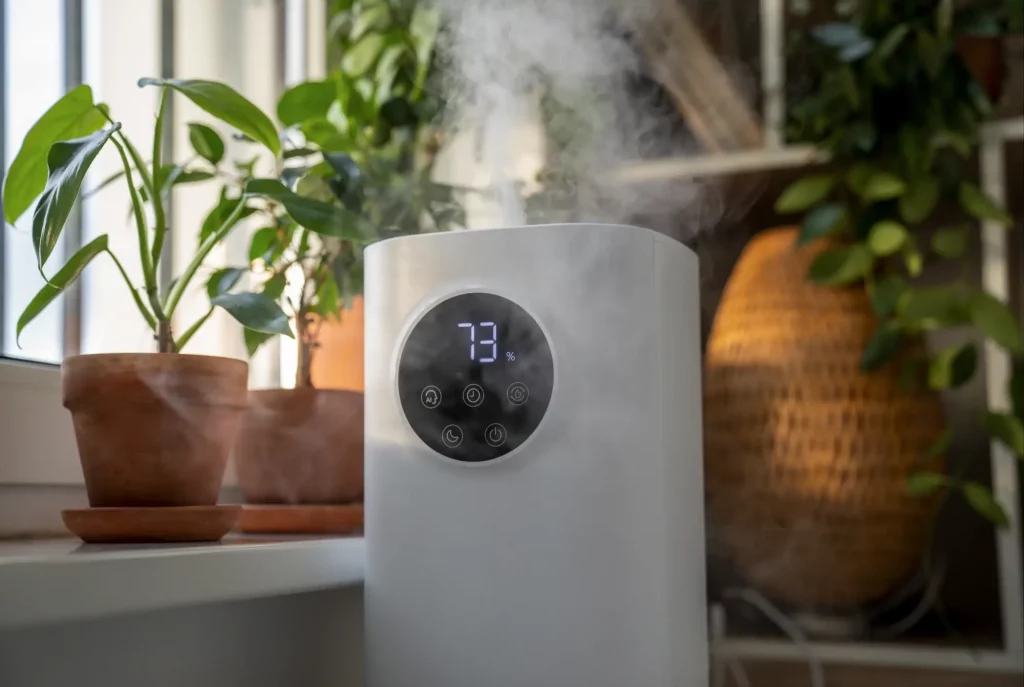
A built-in humidistat, automatic mode or app reading can help avoid blindly running the unit. It does not remove the need for a separate hygrometer near the plants, because the sensor position on the humidifier may not represent conditions on a shelf across the room. Look for a control you understand: a simple automatic mode may be enough, while an app, schedule or setpoint can help in a larger room. If a manufacturer does not clearly explain its selectable target range, do not assume it has the exact control you want.
Check cleaning and water considerations before you buy
Humidifiers need regular cleaning. Stale water, biofilm and mineral build-up are not helpful in a living space, and hard water can leave deposits or visible white dust with some ultrasonic-style models. Follow the manufacturer cleaning instructions, empty the tank when appropriate and use the recommended water approach for your model. An evaporative humidifier may trade the visible mist plume for filter maintenance. A warm/cool unit may offer flexibility but can add power use and more parts. Neither is automatically better; choose the maintenance routine you will actually keep up.Do Your Indoor Plants Actually Need a Humidifier?
Humidifiers are most useful for collections that include humidity-sensitive tropical foliage plants, for plants grouped in a very dry heated room or for winter periods when the relative humidity genuinely falls. They are not a cure for underwatering, poor light, root problems, pest issues or a plant that is simply in the wrong location. Look for evidence before acting. Persistent brown crispy leaf edges, leaves that struggle to unfurl and a consistently low hygrometer reading can justify a closer look, but the same symptoms can have other causes. Check soil moisture, light and temperature as well. Misting is not the same as controlling room humidity. It creates a temporary wetting effect around leaves and does not reliably change the relative humidity of the room for long. A measured, well-placed humidifier is the more controlled option when dry air is truly the issue.Placement and Safe Use Around Plants
- Put the humidifier on a stable, water-resistant surface, not on a plant shelf that can be damaged by spills.
- Keep a sensible gap between the outlet and leaves, walls, wooden furniture and electrical equipment. Do not aim output directly at foliage.
- Place a hygrometer near the plants, not directly above the humidifier outlet.
- Keep air moving gently in rooms where humidity is raised. High humidity plus stagnant air can encourage plant-health problems.
- Use the model’s low-water shut-off feature as a safeguard, not as a substitute for checking the tank and cleaning it.
- Avoid placing a humidifier directly beside a radiator, draughty door or open window, where it may work harder without improving the plant area.
Frequently Asked Questions
What humidity is best for indoor plants?
There is no single ideal number for every indoor plant. Use the needs of the species or plant group, the current room reading and signs from the plant. A broad 40-60% indoor range can be a practical starting point, but it is not a rule that every plant needs or should be pushed towards.Can I run a humidifier all day for my plants?
You can run one when the room measurement and your plants justify it, but avoid treating it as an all-day default. Use a hygrometer, check for condensation and keep gentle airflow in the room. Continuous high humidity in a stagnant space can create different problems.Is warm mist better than cool mist for houseplants?
Neither is automatically better for a plant. The important factors are the room’s actual humidity, safe placement, cleaning and whether the humidifier can maintain a sensible level without creating damp surfaces. Warm mist can be a useful feature for some homes, but it is not a plant requirement.Should I mist plant leaves instead of buying a humidifier?
Misting can briefly wet leaf surfaces, but it does not reliably control the humidity of a room. If the air is consistently too dry, a hygrometer and a properly placed humidifier are the more measurable approach.Can a humidifier cause mould or plant disease?
It can contribute to unwanted dampness if it is overused, poorly placed or combined with stale air. Monitor the room, avoid directing moisture at walls or leaves and make sure the plant area has reasonable air circulation.Keep Learning
How to Increase Humidity for Indoor Plants
Before choosing a humidifier, learn how to measure room humidity, group plants sensibly and raise moisture without creating a damp, stagnant corner. Read our guide to increasing humidity for indoor plants.Final Thoughts
The right smart humidifier for indoor plants is the one that matches a measured need in the right-sized room and that you will clean regularly. For most larger plant collections, the Dreo 713S has the strongest all-round specification. For a smaller room, the Dreo 311S is the more straightforward value choice. The Levoit OasisMist 450S is the easy-to-use warm/cool smart alternative, while SwitchBot is the specialised evaporative option for people who are happy to work within its wider smart-home system. Do not buy on plant aesthetics alone. Measure first, choose a realistic tank and maintenance routine, then use the humidifier to support the room rather than soaking individual leaves.Related Articles
- How to Increase Humidity for Indoor Plants
- Indoor Garden Care Tips for Healthy Plants
- Air Circulation for Indoor Plants Explained
- Best Temperature Range for Indoor Plants
Make humidity easier to control
Choose a Humidifier That Actually Fits Your Plant Setup
The best smart humidifier for indoor plants is the one that matches your space, your plant types, and your willingness to maintain it. Once the size, placement, and humidity target are right, your plants usually respond much better.